


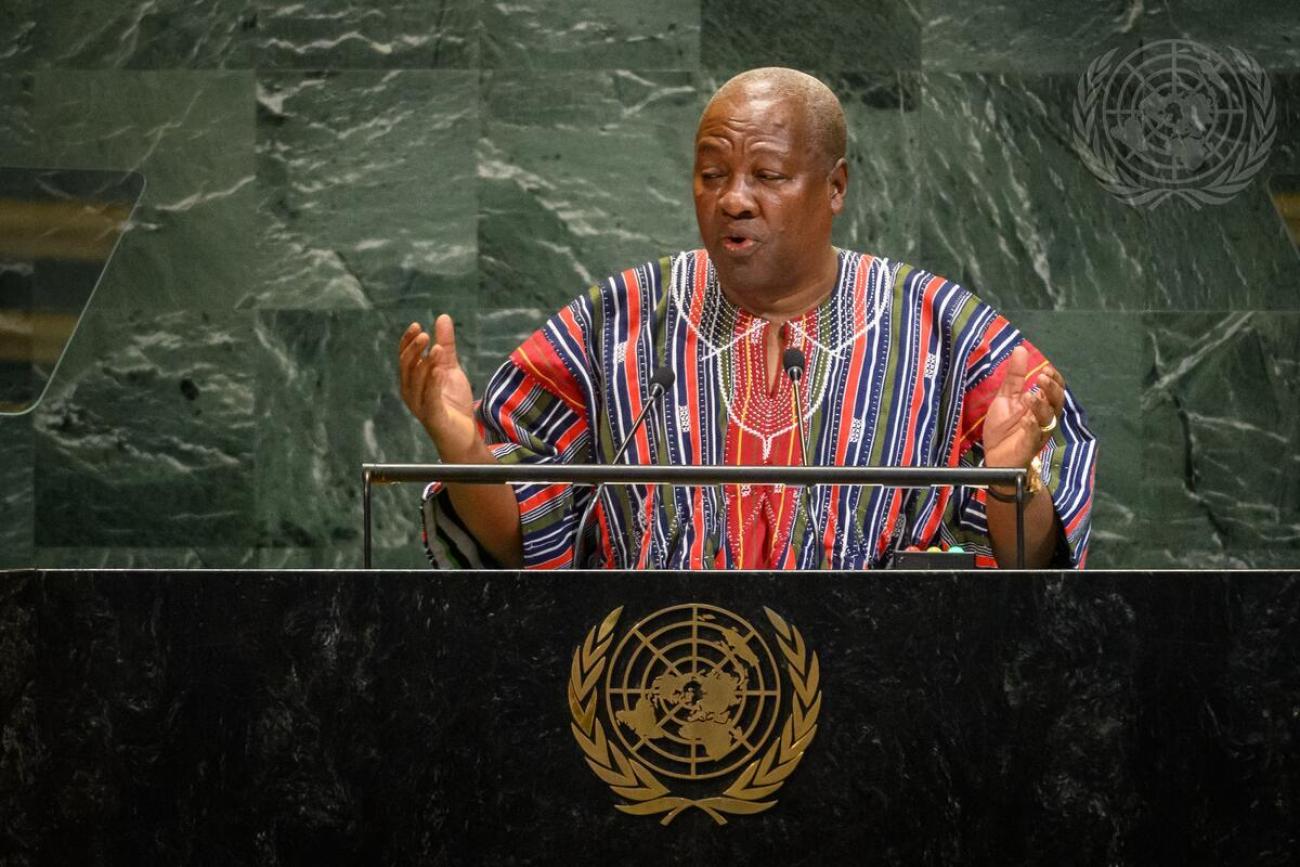
President John Dramani Mahama has told leaders of the Global South that demands for greater control over their affairs must be matched by uncompromising accountability at home.
Speaking at a high-level side event on the Accra Reset: Global Reset Dialogue on the margins of the 81st United Nations General Assembly in New York on Monday, September 21, 2026, President Mahama said countries could not claim sovereignty and control while allowing weak domestic accountability systems to persist.
“If we demand control, we must earn it through uncompromising domestic accountability,” he said, pointing to measures under his Resetting Ghana Agenda aimed at tightening fiscal controls, fighting corruption and ensuring that every public cedi is accounted for “down to the last pesewa.”
He said the principle must apply across the Global South: “No ownership without control, yes—but no control without absolute accountability to our people.”
President Mahama said the position formed the foundation of what he described as a New Global Bargain, in which responsibility must be matched by authority, authority supported by productive capability, and partners held accountable for their commitments.
From dependence to control
The President linked Ghana’s domestic reform agenda to the broader Accra Reset, which he said was launched a year earlier in response to what he described as the fragmentation and decline of the traditional aid architecture.
He identified three interconnected burdens confronting the Global South—geostrategic marginalisation, geopolitical vulnerability and donor dependence—and argued that overcoming them required stronger political authority, productive capacity and financial resilience.
He said Ghana’s Resetting Ghana Agenda was focused on resetting the national economy, fiscal management, governance structures and the industrial sector, with economic self-reliance, local value addition, transparent governance, public health infrastructure and the 24-Hour Economy initiative forming part of the agenda.
President Mahama argued that national reforms could not be sustained in isolation from global systems that shape trade, finance and development.
“A national reset without a global reset leaves us building on shifting sand. Likewise, a global reset without domestic discipline is unfeasible,” he said.
No ownership without control
The President also challenged the long-standing development model under which countries are expected to take ownership of programmes while key decisions and resources remain controlled externally.
Referencing the 1955 Bandung Conference and the 2005 Paris development agenda, he said political independence had not necessarily translated into control over global trade, finance and health governance.
Through the Accra Reset, he said, the Global South was asserting a new principle: “No Ownership Without Control.”
However, he cautioned that transferring authority from international institutions to national governments would not automatically produce genuine sovereignty.
“Moving power from distant boardrooms in Geneva or Washington into an unaccountable ministry in Accra, Abuja, or anywhere else will not magically manifest sovereignty either,” he said.
Health as first test
President Mahama said health had been selected as the first major testing ground for the global reset, with maternal and child health identified as the initial critical test.
He cited figures indicating that nearly seven out of 10 maternal deaths globally occur in Sub-Saharan Africa and said Ghana’s maternal mortality remains three times above the recommended Sustainable Development Goal target.
He said initiatives including Mother Africa and the Business United for Mothers, Babies and Youth (BUMBY) campaign were intended to bring public policy and corporate responsibility together to improve outcomes for mothers and children.
President Mahama said Ghana would seek to carry the Accra Reset into Africa’s collective policy framework when the country assumes the Chairmanship of the African Union in 2027, working with the Non-Aligned Movement and the G77 plus China.
He formally launched the report A Sovereign Future for Health, which contains 10 recommendations for advancing the proposed new global health architecture.
He said Ghana and the Presidential Council would work with governments, global health bodies, development finance institutions, philanthropies and the private sector to translate the recommendations into country-level compacts.
The President said the objective was ultimately to build a global system in which ownership is backed by real control, cooperation is defined by human dignity and international promises translate into tangible protection for citizens.
By: Christian Kpesese/ NR News