


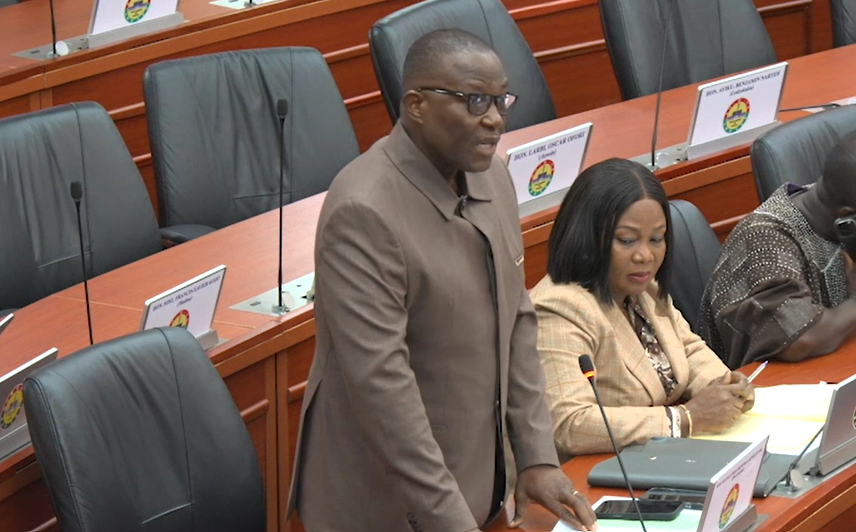
The Member of Parliament for Kpando, Sebastian Deh, has described the 2027 Budget as a decisive shift from macroeconomic stabilisation to productive economic transformation, arguing that improved economic conditions must translate into jobs, import substitution and increased local processing of Ghana’s raw materials.
Contributing to the debate on the 2027 Budget Statement and Economic Policy in Parliament on Thursday November 19, 2026, Mr Deh said the Government’s focus on macroeconomic stability and commercial agriculture demonstrated a deliberate effort to address longstanding structural weaknesses in the economy.
He said the two pillars of the eight-pillar New Economy Budget were particularly significant because they connected improved macroeconomic conditions to investments in productive sectors capable of generating tangible economic benefits.
On macroeconomic stability, the Kpando MP cited the decline in inflation to 5.5 per cent as at October 2026, the movement of the primary balance from deficit to surplus, international reserves covering more than 4.5 months of imports and a reduction in lending rates from approximately 22 per cent to 15 per cent.
According to him, these developments had created the necessary fiscal and financial space for Government to direct resources towards critical productive sectors of the economy.
He argued that the proposed commitment to achieve a primary surplus of 0.5 per cent of GDP, reduce public debt to 45 per cent of GDP and sustain single-digit inflation reflected a deliberate approach to fiscal discipline and responsible economic management.
Mr Deh particularly endorsed Finance Minister Dr Cassiel Ato Forson’s assertion that fiscal space had become a national asset that must be deployed to address the country’s development priorities.
He recalled the Finance Minister’s statement that every cedi of available fiscal space must answer fundamental national questions about the jobs it would create, the imports it would replace and the exports it would generate.
Mr Deh said the statement captured the central economic philosophy of the 2027 Budget, which sought to ensure that macroeconomic gains translated into productive investments and broader economic opportunities.
Turning to commercial agriculture, the MP argued that the proposed interventions offered an opportunity to confront Ghana’s longstanding dependence on exporting raw materials while importing finished products derived from those same resources.
He cited Ghana’s export of raw cocoa beans alongside its importation of chocolate, the export of gold alongside imports of finished jewellery, and the export of bauxite while importing aluminium products as examples of an economic structure that continued to allow other countries to capture a greater share of the value generated from Ghana’s resources.
He said the challenge was not merely to increase production but to develop the domestic capacity to process agricultural and mineral resources, retain more value within the economy and create employment along the production chain.
In that regard, he welcomed the US$3 billion earmarked for commercial agriculture under the second pillar of the Budget, describing it as a significant commitment towards transforming agriculture into a commercially viable and industrially integrated sector.
He highlighted proposed interventions in rice production, sugarcane cultivation, poultry and maize production as important components of the strategy to strengthen domestic production and reduce dependence on imports.
He particularly pointed to the target of developing approximately 100,000 hectares for rice cultivation and processing at least 50 per cent of domestic production locally by 2028.
He also welcomed Government’s ambition to achieve 100 per cent local processing of cocoa by 2030, arguing that greater domestic processing would enable Ghana to retain more value from its cocoa industry while creating employment and expanding industrial opportunities.
The proposed interventions in sugar production, he added, could help advance national sugar self-sufficiency, while increased investment in poultry and maize production would strengthen domestic supply chains and reduce reliance on imported poultry products and feed inputs.
Mr Deh maintained that the distinguishing feature of the 2027 Budget was its attempt to move beyond the repeated policy declarations on value addition by attaching financing commitments and implementation timelines to specific production and processing targets.
He said the connection between macroeconomic stability and commercial agriculture was particularly important: while economic stability created the fiscal space for investment, commercial agriculture provided an avenue to channel those resources into employment creation, food security, import substitution and export development.
The legislator urged the House to support the Budget, describing its policy direction as an important step towards building a productive economy in which Ghana derives greater economic benefits from its own resources.
By: Christian Kpesese