


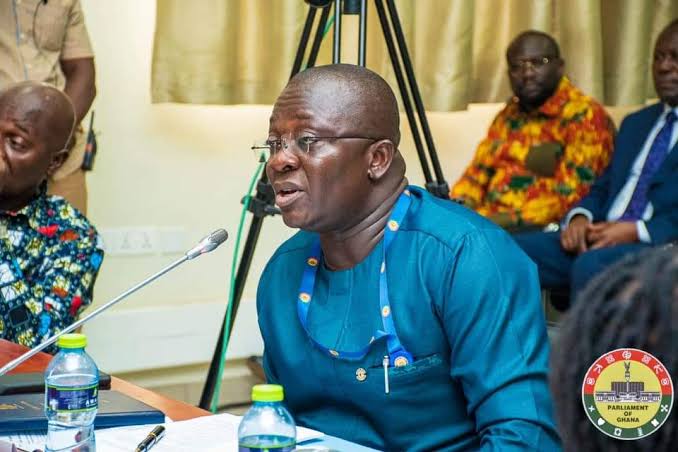
Former Food and Agriculture Minister and Abetifi MP, Dr Bryan Acheampong, has accused the Ministry of Finance of undermining Ghana’s food security through inadequate budgetary releases to the Ministry of Food and Agriculture and the cancellation of a major World Bank-funded programme without the knowledge of the sector minister.
Contributing to the debate on the 2027 Budget Statement in Parliament on Thursday, November 19, Dr Acheampong questioned the government’s commitment to transforming Ghana’s food systems, arguing that inadequate budgetary allocations and funding decisions were undermining agricultural programmes and delaying critical investments.
He cited the cancellation of the Food Systems Resilience Programme (FSRP), which he said was funded by the World Bank, as evidence of poor coordination between the Finance Ministry and the Ministry of Food and Agriculture.
According to Dr Acheampong, the Finance Minister cancelled the programme without prior notice to, or the knowledge of, the Agriculture Minister, Eric Opoku, who subsequently had to write to the Finance Minister seeking clarification.
He described the development as unprecedented and questioned why an existing programme supporting the country’s food systems would be discontinued while the government pursued alternative interventions whose completion depended on major infrastructure projects.
Dr Acheampong also challenged the government’s allocation and spending priorities in agriculture, questioning how the sector’s food systems financing could move from about GH¢2 billion to GH¢24 billion, as he put it, without corresponding improvements in programme delivery.
He referred to allocations under the previous budget for agricultural development, citing GH¢105 million for a programme, with GH¢70 million earmarked for land development, GH¢24 million for irrigation development and GH¢23 million for solar-powered irrigation.
The Abetifi MP further criticised the implementation of the government’s cocoa syndicated programme, which he said had fallen significantly short of expectations.
He recalled that the programme was presented as a major intervention to strengthen domestic cocoa production and reduce the country’s dependence on imported cocoa products.
However, he said that after two budgets, fewer than three million bags had been distributed under the programme, which he considered inadequate relative to the country’s production and consumption requirements.
Dr Acheampong questioned the government’s ability to deliver on its cocoa-sector promises, including its pledge to improve the earnings and livelihoods of cocoa farmers by 2029.
He also drew attention to what he described as a sharp decline in budget releases to the Ministry of Food and Agriculture, saying the ministry received about 70 per cent of its approved budget in 2024 but only 17 per cent by September 2025.
He argued that the Finance Ministry should prioritise the release of funds for agricultural programmes rather than engage in what he described as actions that undermine the work of the Agriculture Ministry.
The MP also questioned the sequencing of the proposed Pwalugu irrigation development, insisting that the dam must be constructed before downstream irrigation infrastructure could be developed.
He warned that developing irrigation facilities before completing the dam could expose the entire investment to failure if the water source was not secured.
On infrastructure financing, Dr Acheampong criticised the government’s record on payments to road contractors, claiming that arrears payments had remained below 10 per cent in both the previous and current budget periods.
He questioned the allocation of more than GH¢10 billion for payments to contractors when, in his view, genuine contractors who had already executed public works were still owed substantial sums.
He argued that delayed payments were denying contractors the resources needed to sustain their operations and contribute to economic activity.
Dr Acheampong urged the government to address what he described as weaknesses in budget execution, warning that allocations on paper would not translate into economic growth or improved livelihoods without timely releases and payments.
By: Christian Kpesese