


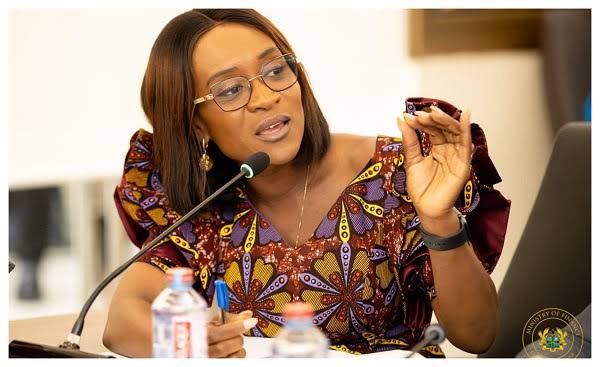
The Chairperson of Parliament’s Public Accounts Committee and Member of Parliament for Atiwa East, Abena Osei-Asare, has challenged the credibility of the government’s fiscal projections in the 2027 Budget, questioning its revenue targets, widening deficits and ambitious capital expenditure plans.
She argued that inconsistencies in the budget figures and what she described as unrealistic economic assumptions raised serious concerns about the government’s claim of pursuing fiscal consolidation and expenditure discipline.
Contributing to the debate on the 2027 Budget in Parliament on Wednesday, November 18, the former Deputy Minister for Finance said the government’s projected economic growth figures did not reflect the scale of investment it was promising under its New Economy programme.
She questioned why, despite the government’s proposed spending of GH¢100 billion on capital expenditure and substantial allocations to the New Economy, economic growth was projected to decline from 5.2 per cent in 2027 to 5 per cent in 2028 and remain at 5 per cent in 2029 before rising sharply to 8 per cent in 2030.
She said the projected increase required a convincing explanation, particularly when the budget’s own projections indicated declining oil revenues by 2030.
“Things don’t add up. You claim you are putting in so much money. The economy, the growth is coming down, and then at the end of the programme, we see a huge rise. Which miracle is that?” she asked.
She argued that the government needed to explain the assumptions underpinning the projected 8 per cent growth, insisting that economic expansion required deliberate policy interventions and measurable investments rather than optimistic projections.
Questions fiscal consolidation claims
Abena Osei-Asare also challenged the government’s claim of pursuing fiscal consolidation, citing projected increases in the overall fiscal deficit over the medium term.
She said the overall deficit on a commitment basis was expected to increase from 2 per cent in 2026 to 2.9 per cent in 2027, before declining slightly to 2.8 per cent in 2028 and rising again to 3.4 per cent in 2029 and 2030.
She questioned how the government could describe its fiscal strategy as consolidation when its own projections showed the deficit widening.
The Atiwa East MP further criticised the proposed reduction in the statutory primary balance from 1.5 per cent to 0.5 per cent, arguing that the move would reduce the fiscal buffers available to the country.
She also highlighted what she described as inconsistencies between the government’s projected primary balance surplus of GH¢9.1 billion and a projected primary cash deficit of GH¢4.8 billion.
According to her, the difference between commitment-based and cash-based fiscal outcomes required further explanation from the Finance Minister.
She cited a projected overall deficit of GH¢5.9 billion on a commitment basis against GH¢65.8 billion on a cash basis, arguing that the latter provided a more realistic picture of the government’s financial position.
“Fiscal discipline will not be judged by one favourable number, the primary balance. But let us look at all the components that make up fiscal discipline,” she said.
Cast doubts on GH¢323bn revenue target
The former Deputy Finance Minister also questioned the government’s projected revenue of GH¢323 billion for 2027, representing an expected increase of 18 per cent.
She contrasted this with projected expenditure growth of 23 per cent to GH¢389 billion, arguing that the revenue target was not sufficiently supported by the government’s actual revenue performance.
She recalled that the Finance Minister had indicated that the government would not introduce new tax measures, questioning how the substantial revenue increase would be achieved.
She particularly raised concerns about the performance of Value Added Tax (VAT) and excise duty collections.
On VAT, she questioned the basis for projecting GH¢49 billion in 2027 when the government had struggled to meet its revised 2026 target.
She similarly questioned the projected increase in excise duty revenue, citing an underperformance against the 2026 target.
She argued that the government’s revenue projections needed to be grounded in realistic economic activity and demonstrated collection capacity.
Interest payments raise concerns
Abena Osei-Asare further questioned the government’s borrowing and debt-management claims, pointing to projected increases in interest payments over the medium term.
She said interest payments were expected to reach GH¢61 billion in 2027 and rise to GH¢102 billion by 2030.
She argued that the projected increases contradicted the government’s narrative of prudent borrowing and fiscal discipline.
According to her, a credible assessment of fiscal consolidation must consider the overall cost of borrowing and the resources committed to servicing public debt.
“The numbers are not saying that. It is not the NPP saying. It’s not the Minority saying. It is your numbers in the budget that are speaking to this,” she told Parliament.
Identifies inconsistencies in budget figures
The Public Accounts Committee Chairperson also raised concerns about discrepancies in the figures presented in different sections of the 2027 Budget Statement.
She cited capital expenditure figures on page 78 and Appendix 3A, which she said showed GH¢28.24 billion and GH¢104 billion respectively.
She questioned which of the figures Parliament was expected to approve.
She also highlighted discrepancies in figures relating to other expenditure items, arguing that such inconsistencies undermined the credibility of the budget and Parliament’s ability to scrutinise public spending.
She called on the Finance Minister to clarify the figures before Parliament approved the estimates.
Questions GH¢100bn capital expenditure ambition
A major concern raised by the Atiwa East MP was the government’s plan to increase capital expenditure to GH¢100 billion in 2027.
She questioned what informed the substantial increase, particularly given the government’s record of failing to fully execute its capital expenditure allocations in previous years.
She cited provisional expenditure of GH¢20.2 billion against a 2025 capital expenditure budget of GH¢22.7 billion.
For 2026, she said capital expenditure was initially budgeted at GH¢67.5 billion, but actual expenditure stood at approximately GH¢41.4 billion.
She challenged the government to demonstrate that the procurement and implementation constraints that had previously affected capital expenditure had been resolved.
She argued that without addressing those bottlenecks, the GH¢100 billion target risked becoming another ambitious budget commitment that would not translate into completed infrastructure and productive investment.
Raises questions over Accra-Mallam Expressway financing
Abena Osei-Asare also challenged the government’s presentation of the financing arrangements for the proposed Accra-Mallam Expressway project.
She questioned claims that the government was not borrowing to finance the road, arguing that mineral royalties and other revenue streams had been committed to the project.
She maintained that committing future mineral revenues to finance infrastructure was itself a form of resource-backed financing that needed to be transparently disclosed.
She further questioned why the government was presenting the project as requiring no borrowing while relying on borrowing to finance other budget commitments.
She called for greater clarity on the financing arrangements and the extent to which future mineral revenues had been committed to the project.
Her contribution added to growing scrutiny of the government’s fiscal assumptions, capital expenditure ambitions and claims of economic consolidation as Parliament continued its debate on the 2027 Budget.
By: Christian Kpesese