


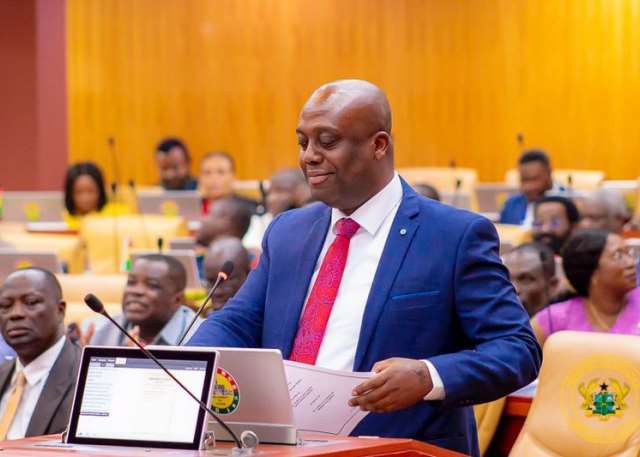
Finance Minister Dr Cassiel Ato Baah Forson is expected to use the 2027 Budget Statement to outline a new economic direction aimed at reducing Ghana’s dependence on commodity-driven foreign exchange earnings, strengthening external reserves and repositioning the private sector as the engine of economic transformation.
The proposed shift, described by government as the New Economy, will seek to address structural weaknesses in the economy by diversifying sources of foreign exchange and reducing the country’s vulnerability to fluctuations in international commodity prices, particularly gold and cocoa.
Speaking to Parliamentary reporters ahead of the budget presentation today, Deputy Finance Minister, Thomas Nyarko Ampem said Ghana could not continue to rely heavily on gold to sustain its foreign exchange reserves, despite the country’s current advantage from favourable international gold prices.
He said although the government was taking advantage of the prevailing gold market to strengthen reserves, the strategy must be complemented by deliberate efforts to modernise and restructure the economy.
“Because we don’t control gold prices, and we know that there will be the possibility that tomorrow gold prices will plummet and it will have an effect on us. We need to modernise the new economy, change the structure of our economy, so that we can have other ways of building the reserves,” he said.
Mr Nyarko Ampem said the government’s immediate priority was to utilise the country’s natural resource endowments while creating sustainable alternative sources of foreign exchange to protect the economy against external shocks.
He hinted that the 2027 Budget would introduce measures to ease pressure on the cedi by addressing underlying foreign exchange challenges.
On taxation, the Deputy Minister assured that government would not introduce new taxes in the 2027 fiscal year.
He also indicated that the government was targeting a higher economic growth rate in 2027 than its 2026 projection, expressing confidence that the economy would outperform its current-year target.
He cited economic growth of 6.2 per cent in the first half of 2026 as an indication of the economy’s improving performance.
Women Development Bank and manufacturing finance
The operationalisation of the Women Development Bank is also expected to feature prominently in the government’s economic policy direction.
Mr Nyarko Ampem disclosed that the bank was expected to commence full operations in 2027, with its licensing process at an advanced stage at the Bank of Ghana.
He said government had already paid approximately GH¢400 million allocated to the institution in the 2026 Budget and was likely to make an additional allocation in the upcoming budget.
However, he emphasised that the institution would operate as a properly governed and financially sustainable bank rather than a political funding vehicle dependent on annual government allocations.
He said its primary responsibility would be to provide accessible financing, on favourable terms, to support women-led businesses.
The Deputy Minister also outlined a new approach to attracting foreign investment, indicating that government would identify priority projects and encourage private-sector participation through targeted incentives and financing arrangements.
He said investor interest in Ghana had improved, with several investors expressing interest in doing business in the country.
However, government was not in a hurry to return to the international bond market, preferring to improve Ghana’s credit rating and secure more favourable borrowing conditions before undertaking further external borrowing.
Minority demands accountability over 2026 allocations
While government presents its economic transformation agenda today, the Minority Caucus is demanding a detailed account of the implementation of the 2026 Budget, particularly whether government has managed public revenue and expenditure within the targets approved by Parliament.
Former Deputy Finance Minister and Chairperson of Parliament’s Public Accounts Committee, Abena Osei-Asare, said the Minority expected the Finance Minister to provide a comprehensive account of the allocations made in the current fiscal year and demonstrate how the approved resources had been utilised.
The Minority’s concerns centre on revenue performance, expenditure commitments and whether government has lived within the fiscal targets approved by Parliament.
It has also questioned the premise of government’s proposed New Economy agenda, arguing that the administration must first account for the state of the existing economy and its management of public resources before promising a new economic direction.
The 2027 Budget is therefore expected to face scrutiny not only over government’s proposed structural transformation agenda but also over its ability to demonstrate fiscal discipline, deliver on existing commitments and translate improved macroeconomic indicators into tangible benefits for Ghanaians.
By: Christian Kpesese