


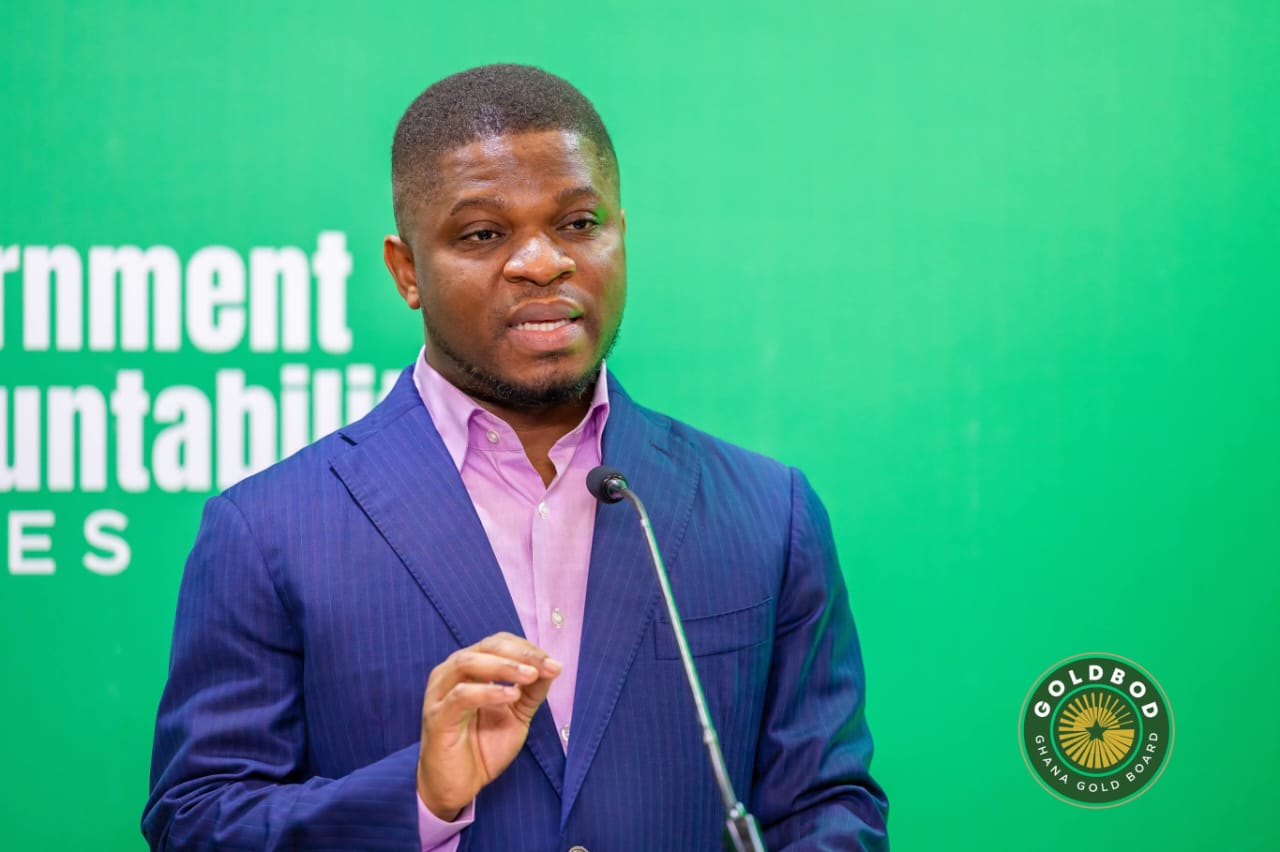
The Chief Executive Officer of the Ghana Gold Board (GoldBod), Sammy Gyamfi, has mounted a strong defence against allegations that he endorsed illegal mining, accusing critics of misrepresenting his remarks through a selectively edited video while defending the government’s strategy of transitioning eligible informal miners into the regulated sector.
GoldBod says the video, taken from an engagement with artisanal and small-scale miners in March 2026, was edited to remove the context of Mr Gyamfi’s comments on the government’s policy to identify, document and formalise eligible operators rather than leave them working outside the regulatory system.
In a statement issued on Saturday, October 24, the institution rejected claims that its CEO had given approval for illegal mining, insisting that formalising eligible informal mining operations is fundamentally different from endorsing galamsey.
“The attempt is false and fundamentally misrepresents the substance and context of the CEO’s remarks,” the statement said.
GoldBod maintained that the government’s objective was to end illegal mining by creating a pathway for eligible operators to obtain the necessary licences, comply with regulations and adopt environmentally responsible practices.
The defence comes amid renewed scrutiny of Mr Gyamfi’s remarks on mining without licences, with the controversy raising questions about the distinction between bringing informal miners into the formal economy and permitting operations that violate the law.
The Board argued that its position was consistent with a broader approach to mining regulation that combines enforcement with formalisation, access to finance, technical support and accountability.
At the 2026 Mining in Motion Summit, Mr Gyamfi reiterated the need for practical and inclusive regulation that goes beyond policing miners to building their capacity and creating incentives for compliance.
Formalisation and financing programme
At the centre of GoldBod’s defence is its proposed Artisanal and Small-Scale Mining (ASM) Formalisation and Financing Support Programme (FFSP), which is expected to be rolled out in 2027.
The initiative is being pursued in collaboration with the Ministry of Lands and Natural Resources, the University of Mines and Technology (UMaT) and the Mineral Income Investment Fund (MIIF), with technical support from Rand Refinery of South Africa.
According to GoldBod, the programme is intended to improve access to financing, increase production and mineral revenues, create jobs, reduce operating costs and address environmental degradation associated with irresponsible mining.
The Board said it had begun consultations with government agencies, small-scale mining associations, civil society organisations and other industry stakeholders to shape the proposed programme before its implementation.
The consultations, it said, were intended to ensure that the policy reflects industry needs and incorporates stakeholder perspectives.
Geological studies to tackle ‘lottery mining’
GoldBod also cited ongoing geological investigations in Funsi in the Upper West Region and Bensere in the Ashanti Region as part of efforts to promote more responsible mining.
The studies are being undertaken in partnership with the Ghana Geological Survey Authority to improve geological knowledge of mineralised areas and reduce what the Board described as “lottery mining” — operations undertaken without sufficient geological certainty, potentially resulting in environmental damage and inefficient extraction.
The institution said the interventions were designed to strengthen responsible sourcing, improve mining practices and make compliance a more viable alternative to operating illegally.
Cites enforcement and environmental investments
In rejecting the allegations, GoldBod further pointed to its support for the National Anti-Illegal Mining Operations Secretariat (NAIMOS), alongside investments in land reclamation, water remediation and mineral traceability.
The Board said it was funding the reclamation of 50 hectares of degraded land in the Tano Nimiri Forest Reserve, supporting the rehabilitation of water treatment plants affected by irresponsible mining and procuring a track-and-trace system to strengthen accountability across the gold supply chain.
“These are not the actions or policies of an institution that endorses illegal mining,” the statement said.
GoldBod maintained that destructive mining practices affecting water bodies and forest reserves must be curtailed, while eligible informal operators should be brought into a system where their activities can be licensed, monitored and held accountable.
The institution said its approach was anchored in Section 3(1)(f) of the Ghana Gold Board Act, 2025 (Act 1140), which mandates it to promote the formalisation of the small-scale mining industry through supply-chain sustainability, among other measures.
It reiterated its commitment to responsible mining, environmental protection and transforming Ghana’s mineral wealth into national prosperity.
The statement, issued by GoldBod’s Media Relations Unit, did not identify the individuals responsible for circulating the video or provide details of any planned legal action over the controversy.
By: Christian Kpesese