


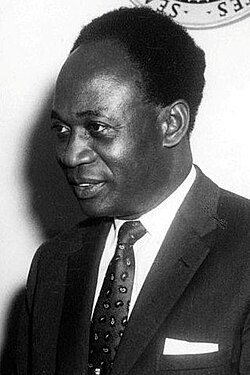
As Ghana marks the 117th anniversary of the birth of Kwame Nkrumah, the most consequential question may not be whether the country still celebrates him.
It is whether Ghana has become the country he imagined.
Born on September 21, 1909, Nkrumah entered the independence struggle with an idea that went beyond political freedom. For him, independence was meaningful only if it delivered economic power, industrial capacity, educated citizens and a society capable of determining its own future.
That remains an unfinished national conversation.
At independence in 1957, Ghana inherited an economy heavily dependent on primary commodities, with limited indigenous industry. Nkrumah’s response was not to manage that inherited structure but to transform it.
His government pursued an ambitious state-led industrialisation programme, culminating in the Seven-Year Development Plan, 1963/64–1969/70.
The plan was remarkably comprehensive. It placed agriculture, industrialisation, employment, education, infrastructure and social development within one national framework. About 20 per cent of total investment was allocated to industry and trade.
The objective was clear: move Ghana from exporting raw materials to producing, processing and manufacturing.
The results were visible.
The Akosombo Dam, Tema industrial complex and harbour, roads, housing and new industrial enterprises became physical symbols of the transformation. By 1966, the Ghana Industrial Holding Corporation had 34 manufacturing units. The country also established institutions such as the Ghana National Trading Corporation, Black Star Shipping Line and expanded the banking and public administration systems.
Nkrumah understood that infrastructure without people would not produce transformation.
Education was therefore treated as national infrastructure.
Between 1951 and the mid-1960s, Ghana’s school system expanded dramatically, from fewer than 1,700 schools serving about 226,000 children to almost 11,000 schools enrolling nearly 1.5 million pupils.
Universities and technical institutions were strengthened to produce the manpower required by a modernising country.
The principle was simple: education was not merely preparation for employment; it was preparation for nation-building.
Health, housing and social services were similarly incorporated into the development strategy.
Agriculture was not viewed as an isolated rural activity. Nkrumah’s plan identified an agricultural revolution as crucial to development because farming was expected to feed the population, supply industry with raw materials, create employment and generate export earnings.
It was a deliberately interconnected economic model.
And then there was the larger African vision.
Nkrumah did not see Ghana’s independence as the final destination. He regarded it as part of Africa’s liberation and argued for continental political and economic unity.
That vision helped shape the establishment of the Organisation of African Unity in 1963, the forerunner of today’s African Union.
His argument has acquired fresh relevance in the era of the African Continental Free Trade Area: a continent rich in gold, cocoa, oil, bauxite, manganese and other resources still struggles to capture sufficient value from what it produces.
The Nkrumah question therefore remains uncomfortable:
Why should Africa continue to export resources and import the higher-value products made from them?
For Ghana, the question is even sharper.
Gold is produced here. Cocoa is produced here. Oil is produced here. Minerals are extracted here.
But how much of the value chain remains here?
That was essentially the economic sovereignty problem Nkrumah confronted.
The public service question
Perhaps the most revealing comparison lies not in the dams or factories, but in the public service.
Nkrumah’s development project required a public service capable of planning, coordinating and executing long-term national priorities. The Institute for Public Administration, established in 1961 and later becoming GIMPA, was part of that effort to build professional public-sector capacity.
Today’s Ghana has a much larger and more educated public sector.
According to the World Bank, approximately 63 per cent of public-sector workers have tertiary education, and Ghana’s civil service has remained relatively capable and stable across political transitions.
Yet the same assessment identifies a troubling gap between institutional capacity and outcomes, citing weak coordination, implementation challenges and political pressures affecting public institutions.
That contrast deserves serious national reflection.
Ghana today has more universities, more professionals, more technology and vastly greater access to information than Nkrumah’s Ghana.
Yet policy implementation remains a recurring national problem.
The National Development Planning Commission has itself acknowledged the continuing challenge of building a stronger industrial base and creating productive employment. It recently noted that more than 75 per cent of Ghana’s labour force is in the informal sector, contributing less than 30 per cent to national productivity.
So, nearly seven decades after independence, Ghana continues to wrestle with some of the structural problems Nkrumah identified.
What should Brand Ghana mean?
This is where Nkrumah’s legacy becomes more than history.
A compelling Brand Ghana cannot be built merely around tourism campaigns, political slogans or patriotic symbolism.
It must be demonstrated through what Ghana produces.
A Ghana that processes its minerals.
A Ghana that adds value to cocoa and agricultural products.
A Ghana that builds competitive industries.
A Ghana whose universities produce research that solves Ghanaian problems.
A Ghana whose public service rewards competence and delivers results.
A Ghana that turns its natural resources into jobs, technology and domestic wealth.
And a Ghana that uses its position to strengthen African economic integration.
That does not mean recreating Nkrumah’s political or economic system. His record remains contested, including the concentration of political power, restrictions on destructive opposition and the economic difficulties that emerged during his administration.
His government was overthrown in the 1966 coup.
But separating those controversies from the development questions he raised is essential.
The point is not to romanticise the past.
It is to recognise that some of the questions Nkrumah asked remain unanswered.
The unfinished Ghana
Ghana is approaching its 70th anniversary of independence in 2027.
The irony is striking.
After nearly seven decades, the country is still debating industrialisation, economic sovereignty, agricultural productivity, public-sector effectiveness, education, job creation, value addition and long-term national planning.
Indeed, the NDPC is now working towards a longer-term national development framework, reflecting renewed concern about policy continuity beyond electoral cycles.
Nkrumah’s greatest challenge to contemporary Ghana may therefore not be found in his speeches or monuments.
It is found in the gap between political independence and economic capability.
The real measure of his legacy is not how often his name is invoked.
It is whether Ghana can finally build the productive economy, capable institutions, educated population and African economic influence that independence was supposed to make possible.
At 117, Nkrumah remains relevant not because Ghana should return to his time, but because the future he demanded from Ghana is still unfinished.
By: Christian Kpesese, Ai assisted.