


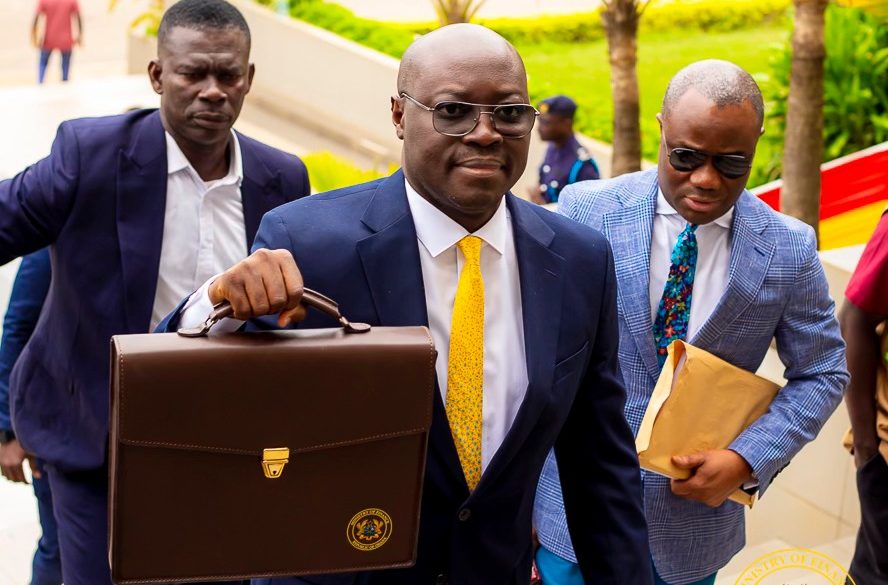
Finance Minister Ato Forson has used the presentation of the 2027 Budget Statement to Parliament to recount the devastating human cost of Ghana’s 2022 economic crisis, acknowledging that households, farmers, pensioners, businesses and investors bore the brunt of the country’s economic collapse.
He said the crisis went beyond deteriorating macroeconomic indicators, leaving families struggling with rising food prices, expensive transportation, higher medicine costs, diminished savings and the collapse of businesses under the weight of high interest rates and rapid depreciation of the cedi.
Addressing Parliament on Thursday, November 12, 2026, Dr Forson said the crisis had forced many households to make difficult choices, including postponing education, housing and healthcare as their purchasing power weakened.
He noted that the consequences of the economic turmoil were particularly severe for farmers and businesses, while the subsequent debt restructuring imposed painful losses on households, pension funds, banks, businesses and investors.
By the end of 2022, inflation had surged to 54.1 per cent, the primary balance had deteriorated to a deficit of 4.3 per cent of GDP, public debt had exceeded 100 per cent of GDP, and gross international reserves had declined to less than three months of import cover.
Dr Forson attributed the crisis to a combination of excessive spending, weak revenue mobilisation and unsustainable debt accumulation, arguing that temporary revenue windfalls had been used to finance permanent government commitments.
He said the experience had exposed fundamental weaknesses in the country’s economic management and underscored the need to ensure that the sacrifices endured by Ghanaians did not become an inherited burden for future generations.
“Mr Speaker, the Ghanaian people paid a heavy price. We owe them something greater than government. We owe them a country that honours their sacrifices and ensures that the hardships they have endured do not become their children’s inheritance,” he said.
The Finance Minister said the government began efforts in 2025 to restore economic order, credibility and stability, pointing to significant improvements in key macroeconomic indicators by the end of that year.
Inflation, which stood at 23.8 per cent at the beginning of the recovery period cited by the Minister, had declined to approximately 5.5 per cent by the end of 2025.
The primary balance also improved from a deficit of 4.1 per cent to a surplus of 2.5 per cent of GDP, while public debt declined to 24.7 per cent of GDP.
Gross international reserves, he added, increased to 5.7 months of import cover, providing a stronger external buffer for the economy.
Dr Forson said the improvements had given households greater certainty and enabled businesses to plan with increased confidence.
He, however, emphasised that economic recovery must ultimately be judged by its impact on people’s quality of life rather than figures alone.
The presentation places renewed emphasis on the need to protect economic stability, strengthen public financial management and ensure that the burden of future economic adjustments does not fall disproportionately on ordinary Ghanaians.
The Minister said the country’s economic gains should create room for transformation that extends beyond electoral cycles and safeguards future generations.
By: Christian Kpesese