


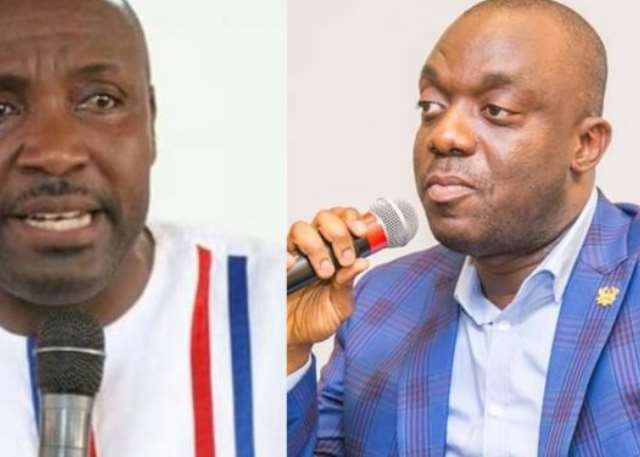
Four years after Justin Frimpong Kodua unseated him in the New Patriotic Party’s (NPP) General Secretary election, John Boadu has made a significant return to the party’s national leadership, this time as National Chairman.
The development has created an intriguing new leadership configuration within the NPP, with Mr Boadu taking the chairmanship while Mr Kodua, popularly known as JFK, retains the General Secretary position he won from him in 2022.
The two men will now occupy two of the party’s most influential national executive positions as the NPP seeks to reorganise its structures and position itself for the 2028 general elections.
Mr Boadu was elected National Chairman at the NPP’s National Delegates Conference held at the Baba Yara Sports Stadium in Kumasi on Saturday, October 3, 2026.
He secured 2,888 votes to defeat former Energy Minister Boakye Agyarko, who obtained 2,048 votes, and former National Chairman Paul Afoko, who polled 490 votes.
Former NPP national executive Sammy Crabbe had withdrawn from the contest and endorsed Mr Boadu.
Mr Kodua, meanwhile, successfully defended his position as General Secretary, securing 4,486 votes.
He defeated former Bortianor-Ngleshie Amanfro Member of Parliament, Sylvester Tetteh, who obtained 1,340 votes, while former Subin legislator, Eugene Boakye Antwi and former National Treasurer of the party, Charles Dwamena polled 162 and 126 votes respectively.
A remarkable reversal
The outcome marks a notable reversal in the political fortunes of Mr Boadu and Mr Kodua.
In July 2022, the two were direct competitors for the General Secretary position, with Mr Kodua emerging as the victor.
Mr Kodua polled 2,837 votes against Mr Boadu’s 2,524, defeating the incumbent General Secretary by 313 votes and taking over the position.
Four years later, their political paths have converged again, but in a different configuration.
While Mr Kodua remains General Secretary, Mr Boadu has moved into the chairmanship, placing him at the head of the party’s national executive structure.
The development means that a former electoral contest between the two men has now given way to a leadership arrangement in which they will have to work together to achieve the NPP’s broader political objectives.
A test of unity
The new arrangement is likely to attract considerable attention within the party, particularly because of the history between the two politicians.
Mr Kodua’s victory over Mr Boadu in 2022 was one of the major highlights of that year’s NPP national executive elections.
His decision to retain the General Secretaryship in 2026, coupled with Mr Boadu’s election as Chairman, however, means that both now have clearly defined but complementary responsibilities within the party’s national leadership.
Mr Kodua has indicated his readiness to work with the new leadership, with the party’s return to power in 2028 as the central objective.
For Mr Boadu, the chairmanship represents a return to the national executive leadership after his defeat in the 2022 General Secretary election.
His new responsibility will include providing leadership at the national executive level at a time when the NPP is seeking to rebuild following its defeat in the 2024 general elections.
The new leadership will therefore face the dual challenge of strengthening internal cohesion and restoring the party’s electoral fortunes ahead of 2028.
New leadership team
The conference also elected a new team of national officers to serve alongside Mr Boadu and Mr Kodua.
Kojo Fosu Boadu was elected First Vice Chairman, with Henry Nana Boakye taking the position of Second Vice Chairman and Nana Akomea becoming Third Vice Chairman.
Daniel Nii Kwartei Titus-Glover was elected National Organiser, while Alfred Kojo Thompson became National Treasurer.
Mavis Hawa Koomson was elected National Women’s Organiser and Abanga Fuseini Yakubu National Youth Organiser.
Ali Suraj retained the National Nasara Organiser position, while Dennis Miracles Aboagye was elected National Communications Officer.
The elections brought together thousands of delegates for the party’s national leadership contest in Kumasi, culminating in the selection of an executive team that will oversee the NPP’s affairs for the next four years.
Looking towards 2028
The significance of Mr Boadu’s election extends beyond his personal political comeback.
His return places an experienced party administrator at the centre of the NPP’s rebuilding process, while Mr Kodua’s retention of the General Secretaryship provides continuity in the party’s organisational administration.
The effectiveness of the new arrangement will ultimately depend on how well the two men and the wider executive team work together.
For Mr Boadu and Mr Kodua, therefore, the political rivalry of 2022 has given way to a new responsibility in 2026.
The new political equation will be closely watched as the NPP begins its preparations for the 2028 elections.
By: Christian Kpesese