


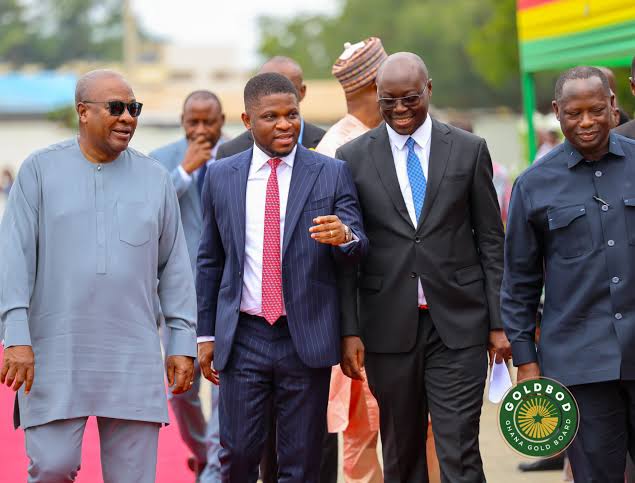
The Government has credited the establishment of the Ghana Gold Board (GoldBod) with generating an additional US$15 billion in foreign exchange inflows, describing the intervention as a transformative macroeconomic policy that has strengthened the cedi, boosted Ghana’s external reserves and restored confidence in the economy.
Presenting the 2026 Mid-Year Fiscal Policy Review to Parliament on Thursday, Minister for Finance, Dr. Cassiel Ato Baah Forson, said GoldBod was at the centre of a complementary fiscal policy introduced by the Mahama administration to support inflation targeting, ensure exchange rate stability and build the country’s external resilience.
“Stronger compliance and smarter administration will always deliver more sustainable revenue than higher taxes,” the Finance Minister told Parliament.
According to Dr. Forson, GoldBod was established to curb gold smuggling, formalise Ghana’s gold trade and ensure that a greater share of the country’s mineral wealth benefits the Ghanaian people.
He said the policy has already produced significant economic gains, generating an additional US$15 billion in foreign exchange inflows, strengthening Ghana’s reserve accumulation and helping to stabilise the exchange rate.
The Finance Minister further disclosed that the GoldBod intervention improved Ghana’s current account surplus by 6.4 percentage points, from 1.9 per cent in 2024 to 8.3 per cent in 2025, representing a fourfold increase within a single calendar year.
“This was not simply a good policy. This was a macroeconomic stabilisation policy designed to strengthen the cedi, build external buffers and restore confidence in the Ghanaian economy,” he said.
Dr. Forson also highlighted government’s implementation of the Ghana Accelerated National Reserve Accumulation Policy (GHANRAP), which aims to increase Ghana’s international reserves to the equivalent of 15 months of import cover by the end of 2028.
To deepen value addition in the mining sector, he announced that government has reached an agreement with large-scale mining companies to purchase 30 per cent of their annual gold production for refining by local refineries, a measure expected to enhance domestic processing while strengthening the country’s reserve accumulation.
He further disclosed that government has amended the Bank of Ghana Act to make inflation targeting a shared responsibility between the Ministry of Finance and the Bank of Ghana, with the objective of improving coordination between fiscal and monetary policy.
Dr. Forson said the combined impact of these reforms demonstrates government’s commitment to building a resilient economy anchored on sound macroeconomic management, stronger external buffers and sustainable long-term growth.
By: Christian Kpesese