


Mr Goosie Tanoh, Presidential Advisor on the 24-Hour Economy and Accelerated Export Development, has appealed to Ghanaians living in the United Kingdom to invest back home to support the 24-Hour Economy and its related initiatives.
Speaking at a town hall engagement in London, Mr Tanoh explained that such support would help fund export-driven value chains, facilitate the transfer of technical skills, and promote partnerships with local industries.
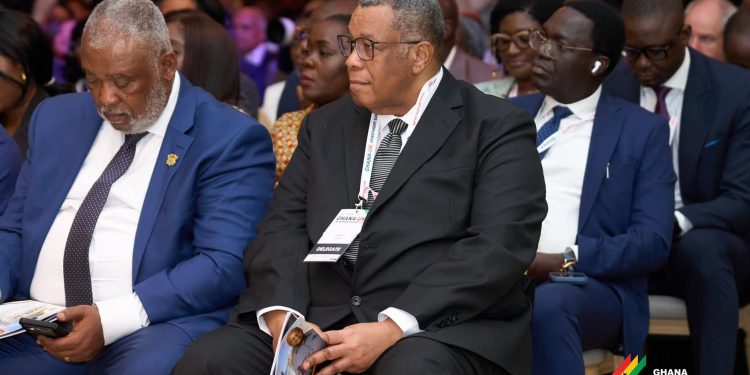
The engagement, organised by the Ghana High Commission in London, formed part of President John Dramani Mahama’s five-day official visit to the United Kingdom. It was designed to connect the President with Ghanaian diaspora communities, update them on the country’s macroeconomic recovery, and encourage investment and skills transfer.
Mr Tanoh’s presentation also served as both a progress report on the flagship policy and a strategic appeal for diaspora capital to drive Ghana’s industrial transformation.
He said that for nearly six decades, Ghana’s economy had followed a recurring pattern of short-lived growth followed by balance of payments pressures and repeated recourse to the International Monetary Fund (IMF).
He noted that Ghana has had 17 IMF programmes since 1966, averaging one every three and a half years.
“Each time we’ve gone to the IMF, for a brief period, our national books are restored for a time. Unfortunately, each time we have gone and come back, the basic structures of our economy, the underlying structural deformity of the inherited colonial economy remains,” he said.
Mr Tanoh said the Reset Agenda being pursued by President Mahama rests on two pillars, with disciplined macroeconomic management as the first. He noted that within 17 months, key indicators had begun to improve.
He cited inflation, which he said had fallen to 3.4 per cent from 3.2 per cent before a recent uptick due to external pressures. He described it as the lowest in over four years and the result of 15 consecutive months of decline.
He added that the Bank of Ghana policy rate had been reduced from 28 per cent to 14 per cent, while the cedi had remained relatively stable within a managed range under the central bank’s oversight.
He further stated that Ghana currently had close to six months of import cover, with the Bank of Ghana holding nearly 38 tonnes of gold on its balance sheet as additional security.
Mr Tanoh also claimed that the trade surplus in the first few months of 2026 alone had reached 68 billion US dollars.
According to him, public debt had declined from a peak of 92.4 per cent of GDP to about 48 per cent, moving towards more sustainable levels. He also said the economy grew by 7.7 per cent in the first quarter of 2026, following 6 per cent growth in 2025.
He credited the Finance Minister, the Governor of the Bank of Ghana and the economic management team under President Mahama for maintaining fiscal discipline.
Mr Tanoh noted that while overall growth had improved, the structure of the economy still reflected a heavy tilt towards services, which accounted for about 60 per cent of growth, while agriculture contributed 25 per cent.
He said industry, comprising manufacturing, processing plants and construction, accounted for a smaller share of about 12 per cent, growing at a slower pace.
“Our strategy moves on two deliberate tracks. The first is export led. We are building productive capacity where Ghana has latent advantage,” he said.
He added that work was ongoing across the Volta Economic Corridor, which spans 75 districts around the Volta Lake and its tributaries, focusing on garments, pharmaceuticals and light industries anchored on affordable energy.
Mr Tanoh highlighted four major agreements signed within the past 90 days, collectively projected to create over 160,000 jobs. These include the Buipe Solar Farm, the Kambonwule Oil Palm Anchor Project, the Bioenergy and Biofuels Programme and the Tamale Air Cargo Hub.
He explained that the Kambonwule Oil Palm Anchor Project is a $300 million agricultural initiative aimed at large scale sustainable palm production to reduce Ghana’s vegetable oil import deficit.
He added that the Tamale Air Cargo Hub, earmarked for two operators set to begin operations in 2027, is expected to transform northern Ghana into a major export and logistics corridor.
GNA