



The Member of Parliament for Awutu Senya East, Phyllis Naa Koryoo Okunor, has commended the government’s planned investments in solar power, battery storage and off-grid electricity solutions, saying the initiatives will expand access to reliable energy and put power directly in the hands of Ghanaians.
She said the interventions, outlined in the 2027 Budget, reflected the government’s commitment to making electricity more accessible and affordable while strengthening energy security and supporting households, small businesses and essential public services.
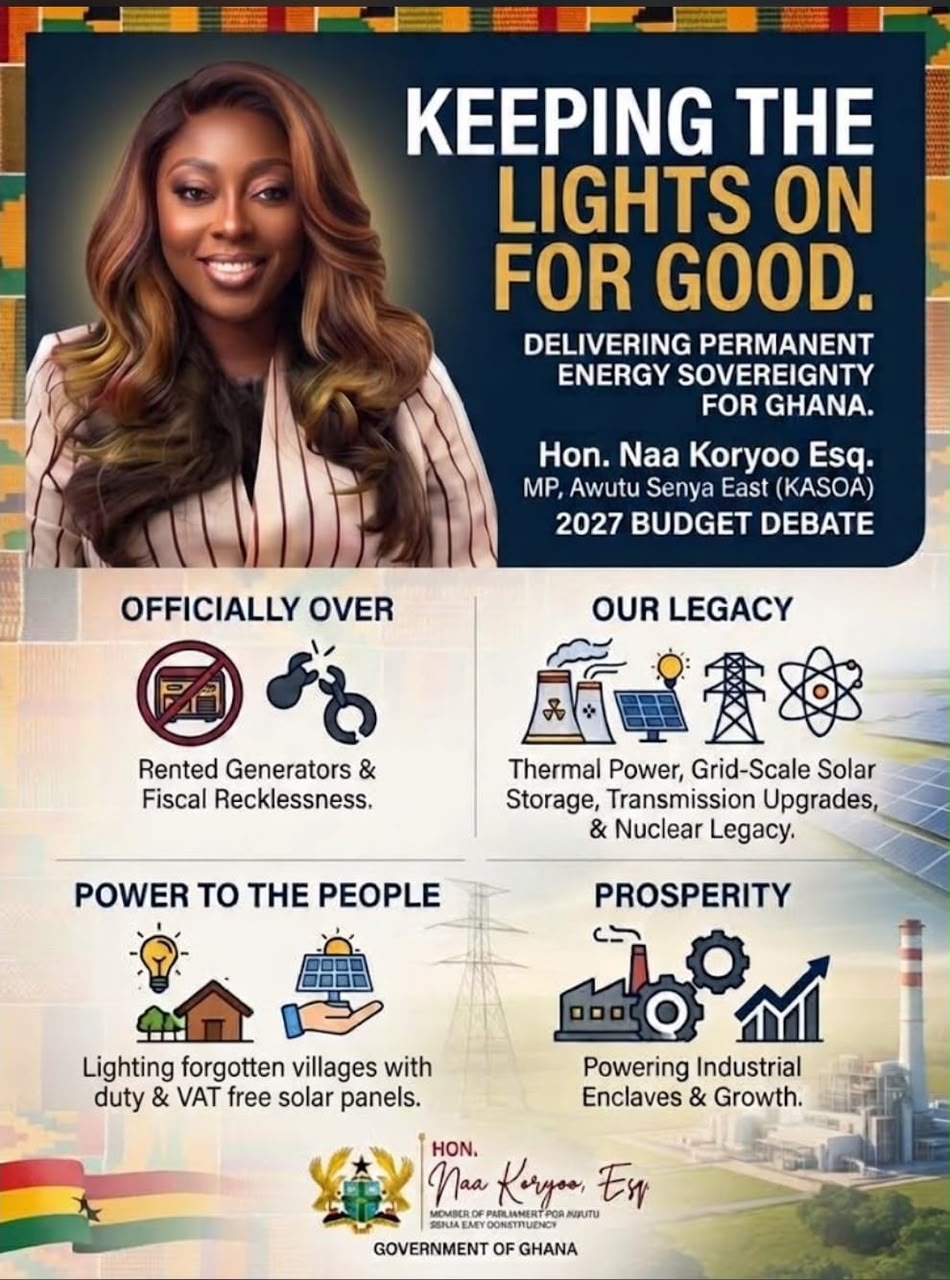 Contributing to the 2027 Budget debate on the floor of Parliament Tuesday November 24, 2026, Ms Okunor highlighted the proposed development of 600 megawatts (MW) of solar power and 22,000 megawatt-hours (MWh) of battery storage as important components of the administration’s strategy to diversify the country’s energy mix and improve grid stability.
She said the investments would help reduce the country’s dependence on conventional thermal generation while providing opportunities to extend electricity access to communities that remain underserved by the national grid.
According to her, the government’s energy programme goes beyond expanding generation capacity to ensuring that ordinary Ghanaians directly benefit from renewable energy technologies.
She particularly highlighted the potential of solar energy to support small businesses, traders and health facilities, enabling them to maintain essential operations and access electricity without being entirely dependent on conventional grid supply.
Ms Okunor also drew attention to the proposed extension of electricity to 47 isolated island and underserved communities in the Volta, Oti, Northern and Savannah regions through the Self-Help Electrification Programme.
She said the intervention would help bridge longstanding electricity access gaps and ensure that communities previously left behind in the country’s development process were included in the national energy expansion agenda.
On the broader energy sector recovery programme, the Awutu Senya East MP said the government was pursuing a combination of thermal generation, renewable energy, battery storage and nuclear energy development to secure Ghana’s long-term electricity needs.
She cited the proposed 1,450MW thermal generation capacity, alongside the solar and battery storage investments, as part of efforts to strengthen electricity supply and improve the reliability of the national grid.
She further welcomed the government’s proposed nuclear readiness programme, which is expected to receive US$200 million over 24 months, with the target of signing an Engineering, Procurement, Construction and Financing contract by 2028.
Ms Okunor said the combination of these interventions would support a more diversified and resilient energy system capable of meeting the needs of households, businesses and industry.
She maintained that expanding access to solar and off-grid electricity was particularly important to ensuring that the benefits of the energy transition reached ordinary people, rather than remaining concentrated in major urban centres.
The MP said the ultimate objective of the government’s energy initiatives was to secure reliable electricity for all Ghanaians, reduce energy costs and create an enabling environment for economic growth and industrial development.
By: Christian Kpesese