


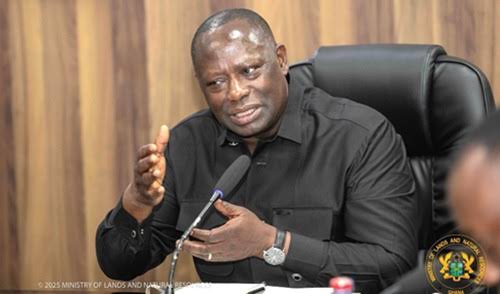
Lands and Natural Resources Minister, Emmanuel Armah-Kofi Buah, has announced plans to establish a 24-hour critical minerals processing enclave in the Western Region as part of a US$1.5 billion investment framework to accelerate local mineral processing, strengthen logistics and maximise value addition to Ghana’s natural resources.
The initiative, which forms part of the fourth pillar of the government’s eight-pillar economic architecture, is expected to support a target of processing at least 70 per cent of Ghana’s artisanal and small-scale gold locally by December 2027, while positioning the country as a major mineral processing hub.
Contributing to the parliamentary debate on the 2027 Budget Statement and Economic Policy on Tuesday, November 24, 2026, the Ellembelle MP said the government was determined to move beyond the export of raw materials and build domestic industries capable of generating higher-value jobs, expanding industrial capacity and retaining more mineral revenues locally.
He further announced that the government was targeting local processing of at least 50 per cent of manganese and bauxite production by the end of 2028, with the goal of achieving full local processing by 2030.
To support these targets, he said the government was also pursuing the transformation of the Western Railway Line to facilitate the movement of minerals from production centres to the Takoradi Port.
Mr Buah said the railway development would reduce reliance on heavy-duty trucks for mineral transportation, ease pressure on roads and improve the efficiency of the country’s mineral processing and export infrastructure.
He argued that Ghana must deploy its petroleum and mineral revenues to finance transformational infrastructure capable of delivering long-term economic benefits, rather than allowing the country’s natural resource wealth to leave limited visible development outcomes.
On forestry management, the Minister reported progress in efforts to restore degraded forest reserves and strengthen environmental protection.
He said Ghana had received international recognition for its forest protection efforts, securing 7.5 million tonnes of carbon credits valued at approximately US$46 million.
He also disclosed that Ghana had qualified to export legal timber to the European market, describing the development as evidence of improvements in forest governance and sustainable timber management.
Mr Buah said the government had consistently planted approximately 10 million trees annually to restore degraded forest landscapes, improve forest cover and strengthen climate resilience.
He disclosed that the 2027 Budget had allocated GH¢1.4 billion to the natural resources sector, including GH¢400 million for land reclamation, GH¢200 million for anti-illegal mining operations and GH¢60 million for mineral resource activities, alongside funding for cooperative mining initiatives.
On the fight against illegal mining, the Minister outlined a five-pronged strategy involving public engagement, mining sector reforms, enforcement, land reclamation and the formalisation of small-scale mining.
He said approximately 8,900 hectares of land had been destroyed by illegal mining, an area he compared to about 12,500 football fields, requiring urgent restoration.
According to him, the government had reclaimed more than 200 acres of degraded land during the year, with additional restoration activities expected in 2027.
He said the establishment of the National Anti-Illegal Mining Operations Secretariat (NAIMOS) had strengthened enforcement efforts, while the proposed allocation for land reclamation would support the restoration of devastated mining sites.
The Minister also highlighted the Responsible Cooperative Mining and Skills Development Programme as an alternative pathway for people engaged in illegal mining to transition into regulated and environmentally responsible operations.
He said more than 10,000 small-scale miners had been trained in responsible mining practices, with the government supporting the formation of cooperatives and providing technical assistance and equipment.
Mr Buah further announced comprehensive reforms to the mining sector, including the replacement of the existing mining policy introduced in 2014 and the introduction of a new mining law currently before Parliament.
The proposed reforms, he said, would strengthen community participation in the mining lease process, revise the licensing framework and expand Ghanaian participation in the industry.
He said the reforms would also introduce a stronger medium-scale mining framework to enable Ghanaian businesses to progress from small-scale operations to medium- and eventually large-scale mining.
On local content, the Minister said the government was determined to move Ghanaians beyond lower-level participation in the mining industry and empower local businesses to occupy more strategic positions across the mineral value chain.
He said the objective was to ensure that the country’s mineral resources delivered greater economic benefits to citizens through local ownership, processing, industrial development and employment creation.
The Minister also highlighted improvements in land administration through the expansion of digital land management systems.
He said the digital gated workflow system for land administration was being extended to several regions, including Ahafo, Bono East, Eastern, North East, Oti, Savannah and Upper East, to improve land registration, reduce delays and eliminate unnecessary intermediaries.
Mr Buah said the various interventions reflected the government’s commitment to restoring degraded lands and water bodies, strengthening forest protection, promoting responsible mining and ensuring that Ghana derived greater value from its natural resources.
He described the 2027 Budget as an opportunity to transform the country’s natural resource wealth into sustainable jobs, industrial growth and long-term prosperity.
By: Christian Kpesese