


By: Albert Amekudzi
When the High Court sentenced Bernard Antwi Boasiako, popularly known as Wontumi, to 20 years’ imprisonment over offences relating to mining activities on Akonta Mining’s concession, the headlines understandably focused on the man and the punishment.
But the real story is much bigger than Wontumi.
Whether one agrees with the judgment or believes it should be overturned on appeal, one thing is certain: this case has the potential to change the way mining companies operate in Ghana for years to come.
In fact, this may become one of the most important legal decisions in Ghana’s mining sector since Parliament strengthened the Minerals and Mining Act to fight illegal mining, commonly known as galamsey.
This Case Was Never Just About Illegal Mining
Many Ghanaians have followed the case as another illegal mining prosecution. That is understandable because illegal mining has dominated national conversations for nearly a decade.
However, the judge was not simply deciding whether illegal mining took place inside Akonta Mining’s concession. The central legal question was surprisingly straightforward:
Can the holder of a mining lease allow another person to mine on the concession without first obtaining approval from the Minister responsible for Lands and Natural Resources?
The Court’s answer was clear. No.
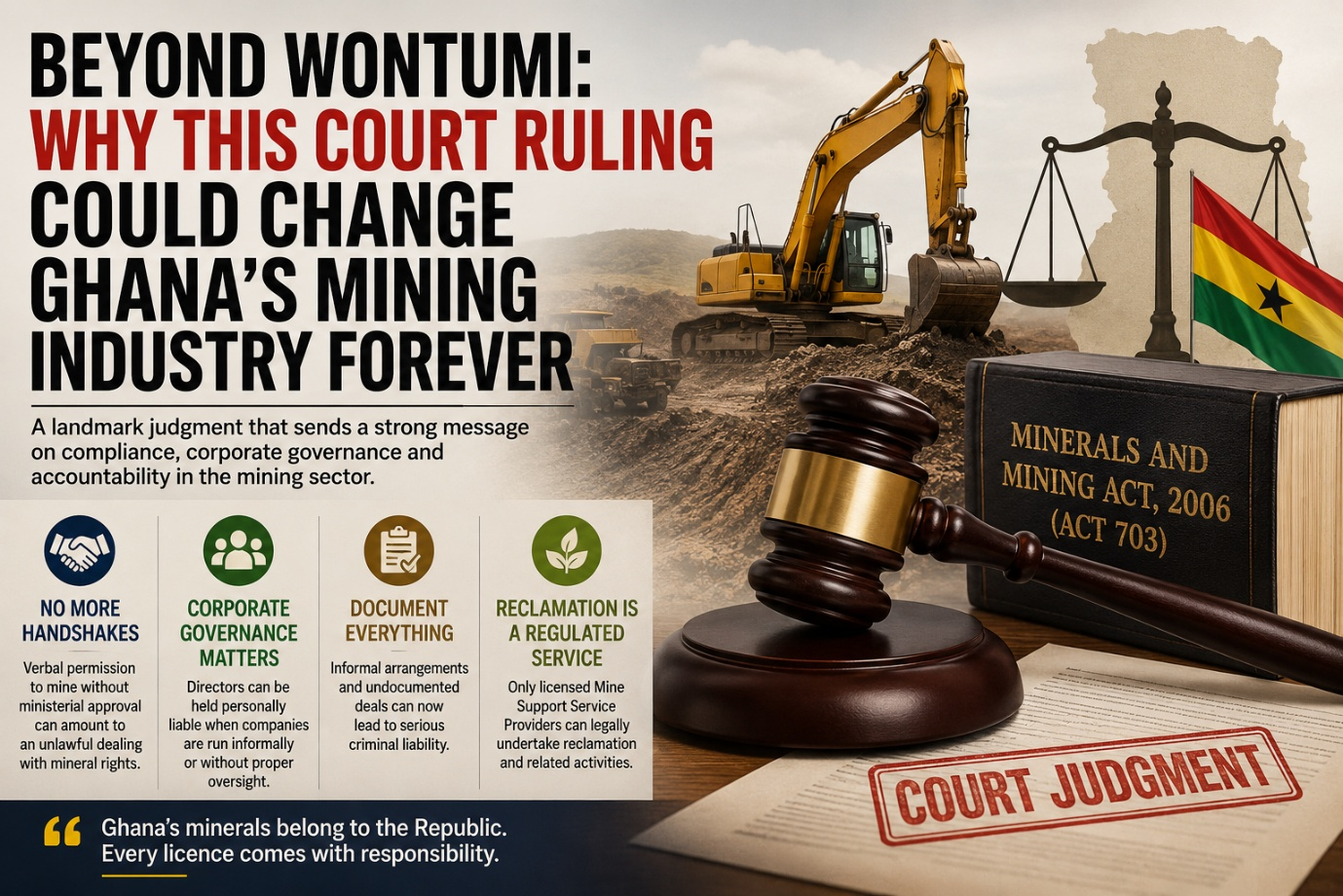
More importantly, the Court ruled that it does not matter whether that permission was contained in a formal written agreement or given verbally. Once another person is allowed to exercise rights that belong exclusively to the licence holder, the law may regard that as an unlawful dealing with the mineral right.
That interpretation is likely to influence many future mining cases.
A Message to Every Mining Company
One lesson from the judgment stands out above all others. Owning a mining lease does not give a company unlimited freedom to decide who operates on its concession.
The State grants mineral rights under strict conditions because Ghana’s minerals belong to the Republic, not to private companies. A mining lease gives a company the right to exploit those minerals, but only within the framework established by law.
The Court has now reinforced that principle. If a concession holder allows another individual or company to mine without following the legal approval process, it could face criminal consequences.
This is likely to make mining companies far more cautious about informal operational arrangements.
The Days of Handshake Agreements May Be Coming to an End
One of the most striking aspects of the judgment is the Court’s treatment of informal agreements.
Across many sectors in Ghana, business relationships often begin with trust. A handshake, a telephone conversation or a verbal understanding may be enough to get work started.
In mining, however, the stakes are much higher. The Court made it clear that when dealing with mineral rights, informal arrangements can become legal liabilities.
For concession holders, this should serve as a wake-up call. Every arrangement involving access to a concession should be properly documented, legally reviewed and, where required, approved by the relevant authorities.
Good paperwork is no longer just good administration. It may be the difference between compliance and prosecution.
Corporate Governance Is No Longer Just for Investors
Another important message from the judgment concerns how mining companies are managed. Many people think corporate governance simply means holding board meetings, preparing annual reports or satisfying investors.
This judgment tells us otherwise. The Court found that Akonta Mining was effectively being run through one individual rather than through proper corporate structures. That finding led the judge to “lift the corporate veil” a legal doctrine that allows the courts, in exceptional circumstances, to look beyond the company itself and hold those controlling it personally responsible.
This is not something courts do lightly. But the judgment reminds company directors that the protection offered by incorporation is not absolute.
If directors ignore corporate governance principles, make major decisions informally or fail to separate personal actions from company affairs, they may lose the legal shield that a company normally provides.
For Ghana’s mining industry, this is perhaps one of the most important lessons emerging from the case.
Reclamation Also Matters
Interestingly, the judgment was not only about mining. The Court also addressed land reclamation. Many people assume that reclaiming mined land is simply an environmental activity. Legally, however, the Court held that reclamation is a regulated mine support service.
That means the people carrying out such work must themselves be properly licensed under Ghana’s mining laws.
This finding could have significant implications. Mining companies frequently engage contractors to reclaim degraded land, build roads, provide earthmoving services and undertake other technical work.
Following this judgment, companies may need to conduct much greater due diligence before appointing contractors to perform these activities.
Fighting Illegal Mining Requires Everyone
There is another broader lesson that deserves attention. For years, Ghana’s fight against illegal mining has largely focused on arresting excavator operators, financiers and miners found working illegally in forests and river bodies.
This judgment signals that the law is also prepared to examine the actions of concession holders themselves. If illegal mining occurs because someone knowingly opened the door, facilitated access or ignored legal requirements, the courts may hold that person accountable as well.
That approach reflects an important shift. Illegal mining does not succeed because of miners alone. It often depends on networks of facilitators, financiers, equipment suppliers and individuals who create opportunities for unlawful activities to flourish.
By interpreting the law broadly, the Court has reinforced the idea that accountability must extend throughout the entire chain.
The Appeal Will Matter
It is important to remember that this judgment is unlikely to be the final chapter. Appeals exist for precisely this reason to allow higher courts to review important legal questions.
Several aspects of this decision are likely to receive close attention, including the interpretation of what constitutes “dealing with” a mineral right, the circumstances under which the corporate veil may be lifted and the extent to which circumstantial evidence can establish criminal responsibility.
Whatever the outcome, the appellate courts will have an opportunity to provide greater clarity on these important questions. That clarity will benefit regulators, investors, mining companies and the wider public.
The Bigger Picture
Beyond the personalities, politics and public debate, this case reminds us of something fundamental. Ghana’s mineral resources belong to all of us. Companies that receive mining leases are not simply acquiring commercial opportunities; they are accepting significant legal responsibilities.
Those responsibilities include complying with the law, protecting the environment, maintaining proper governance and ensuring that every activity undertaken on their concessions meets regulatory requirements.
The Wontumi judgment is therefore about much more than one individual or one company. It is about defining the standards expected of every holder of a mining licence in Ghana. Whether the judgment is upheld or modified on appeal, one thing is already clear. The era when informal arrangements, undocumented decisions and weak corporate governance could comfortably coexist with mining licences is rapidly coming to an end.
For the mining industry, the message could not be clearer: compliance is no longer optional it is the licence to operate.