


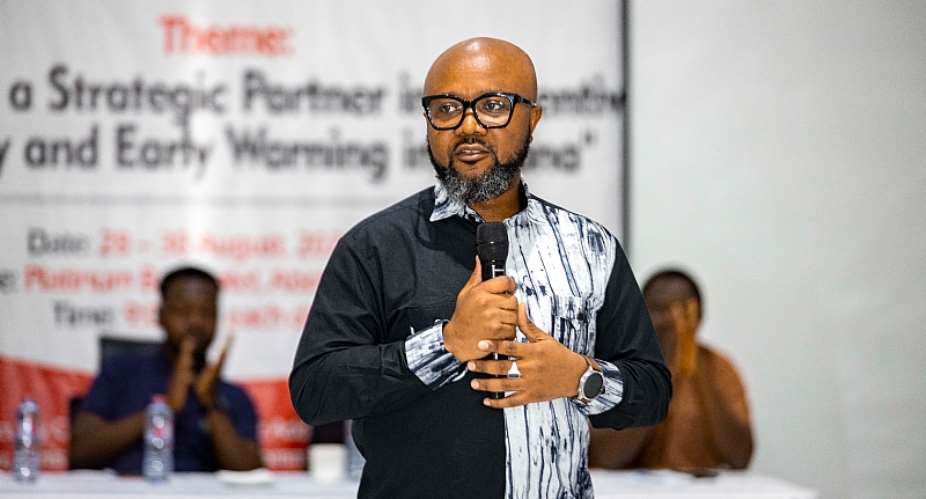
The Director-General of the Cyber Security Authority (CSA), Divine Selase Agbeti, has proposed five practical commitments aimed at bolstering cybersecurity, responsible reporting, and national security within Ghana’s media sector.
According to him, these commitments should serve as a roadmap for newsrooms as they navigate a rapidly changing information landscape, where cybercriminals and malicious actors often take advantage of public trust, fear, and the fast pace of digital communication.
Mr. Agbeti shared these insights during the conclusion of a two-day training workshop for selected members of the Private Newspapers and Online News Publishers Association of Ghana (PRINPAG) by the association in collaboration with the National Security Secretariat in Accra.
The workshop, themed “Media as a Strategic Partner in National Security,” delved into topics such as national security, emerging threats, community conflict, strategic communication, cybercrime, information warfare, ethics, press freedom, and the national interest.
He pointed out that national security isn’t solely the job of security agencies; it’s a collective responsibility where the media plays a vital role.
Mr Agbeti however cautioned that the collaboration between the media and security institutions should never compromise editorial independence or turn journalists into mere extensions of the government.
Instead, he argued that a professional and independent media can enhance national security by exposing wrongdoing, debunking falsehoods, informing the public, and holding institutions accountable.
“Freedom comes with responsibility,” he remarked, highlighting that accuracy, context, and sound editorial judgment are now more crucial than ever for national resilience.
He noted that a professional and independent media strengthens national security by exposing wrongdoing, countering falsehoods, informing citizens and holding institutions accountable.
Five commitments
The first commitment, he said, was for journalists to verify before amplifying, particularly when reporting security incidents, communal conflicts and public emergencies.
Such information, he said, should be independently verified, geolocated where possible and checked against credible official and community sources.
Secondly, newsrooms must protect operations and people by avoiding the disclosure of tactical positions, identities of protected persons, sensitive investigative details or other information that could assist criminals and hostile actors.
Third, Mr Agbeti urged media organisations to build cyber-resilient newsrooms by designating cybersecurity focal persons, regularly training staff, securing official accounts and establishing procedures for escalation, recovery and public correction.
The fourth commitment is to correct misinformation visibly and quickly.
He said corrections should receive enough prominence to reach audiences exposed to the original error, arguing that responsible journalism was demonstrated not by never making mistakes but by responding transparently when they occurred.
The fifth is to strengthen structured engagement between the media and security institutions.
According to him, the CSA would work with PRINPAG to promote regular briefings, awareness sessions, incident-reporting guidance and practical exchanges between journalists and relevant security institutions.
“Trust is built before a crisis, not during one,” he said.
Mr Agbeti also called on PRINPAG to translate the lessons from the workshop into a concise newsroom protocol on national security and cyber-incident reporting.
He said the protocol should preserve editorial independence while establishing clear standards for verification, protection of sensitive information, source security, corrections and liaison with appropriate authorities.
He further urged security institutions to make the partnership reciprocal by communicating promptly, accurately and respectfully with the media.
“The media cannot report responsibly when credible information is unnecessarily delayed or when communication is inconsistent,” he said.
Mr Agbeti noted that Ghana’s security would increasingly depend on the ability to protect both its physical and information spaces, with the media playing an indispensable role in helping citizens distinguish facts from manipulation and legitimate scrutiny from reckless speculation.
He said the CSA remained committed to collaborating with PRINPAG and the wider media community to build safer newsrooms, better-informed citizens and a secure and resilient digital Ghana.
By: Christian Kpesese