


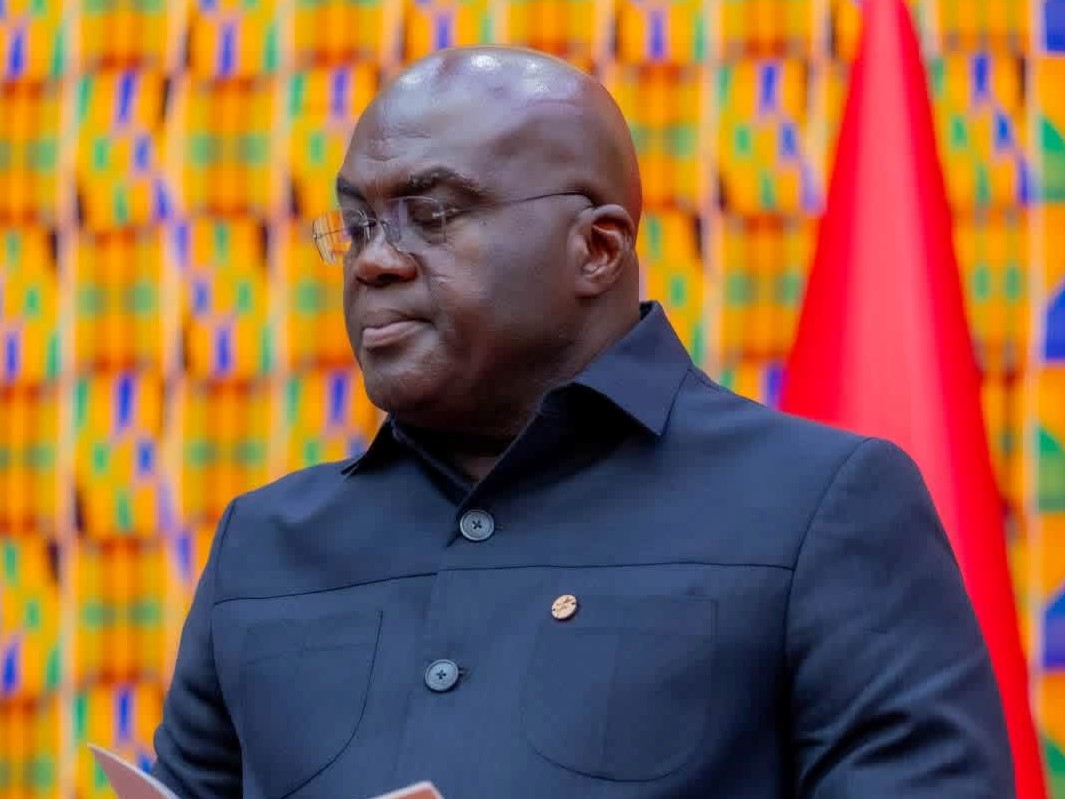
The Chief of Staff at the Office of the President, Dr Julius Debrah, has challenged stakeholders in Ghana’s mining sector to ensure that the wealth generated from the country’s mineral resources translates into visible jobs, businesses and development in mining communities, declaring that “Obuasi should look like gold.”
He said the success of Ghana’s mining industry should not be measured only by production figures, export earnings and government revenue, but also by whether communities that host mining operations experience tangible improvements in their quality of life.
Dr Julius Debrah made this assertion in a speech read on his behalf by Deputy Government Spokesperson, Ms Shalima Muslim at the National Mining Dialogue 2026 in Accra on August 18, 2026.
According to him, mining communities must see and feel the benefits of the resources extracted from their lands in their standards of living.
“If gold leaves a community year after year but clean water, decent roads, jobs and opportunity do not arrive, something is wrong with the bargain,” Dr Debrah said.
He said although national mining statistics might present an impressive picture, the experience of people living in mining catchment areas could tell a different story.
“The national figures may look impressive. The experience in the catchment area would tell a different story, and that is why this dialogue matters,” she said.
Dr Debrah therefore challenged stakeholders to move beyond promises and translate the outcomes of the dialogue into public, measurable and time-bound commitments, cautioning that trust in the mining sector could not be rebuilt through ceremonial communiqués.
He said every proposal emerging from the dialogue must clearly state what will be done, by whom, when and how progress will be measured and reported.
The Chief of Staff said;“Let them be more than ceremonial documents. Let them state what they do, what, when and how progress will be measured and reported. Commitment should be realistic, measurable, time-bound and public. That is how trust is built and rebuilt where it is broken”.
On local content, the Chief of Staff said Ghanaian participation in the mining value chain must be treated as a legal and economic obligation and not as an act of corporate generosity.
“Government’s position remains clear. Local content is a legal and economic obligation. It is not and must not be perceived as an act of charity,” Ms Muslim said on his behalf.
Dr Debrah urged mining operators to demonstrate measurable progress in Ghanaian employment, local procurement, skills development, training and knowledge transfer.
“What is promised must be measurable. What is measured must be subject to scrutiny,” she added.
According to him, stronger implementation of local content requirements would ensure that mining generates sustained opportunities for Ghanaian enterprises and workers across the value chain.
Dr Debrah said Ghana should not be forced to choose between economic livelihoods and protecting its land and water resources.
He acknowledged concerns over environmental degradation, displacement and land-use conflicts and urged the need for such grievances to be addressed fairly through the appropriate institutions.
The Chief of Staff also expressed support for efforts by the Ghana Gold Board (GoldBod) to establish a more regulated and transparent framework for artisanal and small-scale mining.
He said reforms should enable artisanal miners to operate legally, safely and profitably while contributing meaningfully to the formal economy.
Dr Debrah noted that Ghana is now the sixth-largest gold-producing country and said the country must ensure that the wealth generated from gold becomes visible in mining communities.
To strengthen accountability across the sector, Dr Debrah proposed a five-way Catchment Compact involving government, mining companies, traditional authorities, communities, and the media and civil society.
Under the proposed framework, government would provide clear rules, effective regulation and coordination, while mining operators would be expected to honour their commitments and demonstrate measurable progress.
Traditional authorities, he said, should ensure that community benefits are managed transparently, while communities must remain actively engaged in decisions affecting their livelihoods and future.
The media and civil society, meanwhile, would continue to scrutinise the sector and hold all stakeholders accountable.
Dr Debrah said the framework could help create a stronger social contract around mining by clearly defining responsibilities and ensuring that commitments could be tracked.
The Chief of Staff said the Presidency was committed to ensuring that the outcomes of the dialogue translated into improvements that mining communities could see and feel.
“My years in public service have taught me that good intentions alone do not improve lives. As Chief of Staff, I am privileged to help translate President Mahama’s vision into results people can see and feel,” Dr Debrah stated.
He further stated that; “Government will listen, will coordinate and will insist on accountability. It’s not an easy journey. We recognize that, but the commitment is real at the highest level. We ask the same seriousness of every partner”.
Dr Debrah said the ultimate measure of Ghana’s mining legacy should be how wisely the country uses its mineral wealth.
“Let it be said that Ghana did more than export gold. We used it wisely. That we strengthened our reserves, that we protected our water bodies, and that we built sustainable Ghanaian enterprises,” Ms Muslim said on his behalf.
The Chief of Staff commended Semmis DS Group Limited and Asempa FM’s Ekosisen for convening the dialogue.
The National Mining Dialogue 2026 held under the theme “Mining, Local Content and the Catchment Compact: Retaking the Social License” brought together government, mining companies, traditional authorities, small-scale miners, civil society and other stakeholders to examine the future of Ghana’s mining industry.
By: Christian Kpesese/NR NEWS