


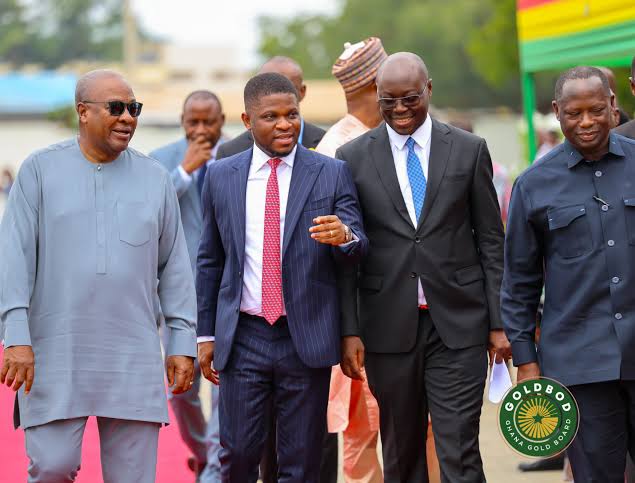
The Chief Executive Officer of the Ghana Gold Board (GoldBod), Mr Sammy Gyamfi, has underscored the critical role of deliberate government policies, strong institutions and decisive leadership in determining who benefits from a country’s mineral wealth.
He said Ghana’s experience under GoldBod demonstrated how purposeful policy reforms could help retain mineral revenue within the country, strengthen foreign exchange reserves, support currency stability and create jobs.
Delivering the keynote address at the 2026 African Minerals Policy Forum, Mining in Motion conference in Accra on Tuesday October 20, 2026, Mr Gyamfi said Africa’s challenge was not a lack of mineral resources but the failure to establish the policies and systems needed to translate those resources into lasting prosperity for its people.
“Geology creates potential. Policy decides who should benefit. Institutions decide whether value is retained or lost. And leadership decides whether a mineral boom becomes a passing statistic or the foundation of lasting transformation,” he said.
Speaking on the theme, “From Gold Production to National Prosperity: Ghana’s GoldBod Model for Mineral Sovereignty and Value Addition,” he said Ghana had chosen to address longstanding weaknesses in the artisanal and small-scale gold mining sector through deliberate institutional and regulatory reforms.
Mr Gyamfi said significant quantities of Ghanaian gold had previously escaped the formal economy through smuggling, under-declaration and informal cross-border trade, depriving the country of foreign exchange and revenue for development.
He cited a SWISSAID analysis of UN Comtrade mirror data, which identified a 229-tonne gap, valued at approximately US$11.4 billion, between Ghana’s reported gold exports and corresponding imports declared by trading partners from 2019 to 2023.
He said GoldBod’s establishment and subsequent reforms had helped address those leakages by formalising local gold trading, introducing a four-tier licensing regime, improving transparent pricing and strengthening monitoring and enforcement against illegal gold trading.
According to him, artisanal and small-scale gold exports increased from 63 tonnes in 2024 to approximately 104 tonnes in 2025, generating US$10.8 billion in foreign exchange.
He said the sector had also recorded strong performance in 2026, with GoldBod aggregating and exporting 85.4 tonnes of artisanal and small-scale gold valued at US$11.6 billion between January 1 and October 20, compared with 76 tonnes valued at US$11.1 billion from large-scale mining over the same period.
Mr Gyamfi described the gains as a “production claw back”, explaining that the reforms had brought gold previously lost to smuggling and illegal trade into the formal economy rather than creating new production.
He also highlighted progress in local gold refining as part of efforts to retain more value within Ghana. He said two locally owned refineries had cumulatively refined 25 tonnes of artisanal and small-scale gold purchased and exported by GoldBod in 2026.
The GoldBod CEO said the institution’s licensing and value-addition reforms had created 4,866 direct jobs in less than two years, comprising 361 public-sector jobs and 4,505 private-sector jobs, with further opportunities emerging for artisanal smelters, jewellers and young entrepreneurs.
He announced plans for GoldBod to introduce an Artisanal and Small-Scale Mining Formalisation and Financing Support Programme next year, in collaboration with the Ministry of Lands and Natural Resources and the University of Mines and Technology, with technical support from Rand Refinery of South Africa.
The programme, he said, would seek to increase production, revenue and employment while reducing operational costs and environmental degradation associated with small-scale mining.
Mr Gyamfi further disclosed that GoldBod was procuring a blockchain-based track-and-trace system to strengthen responsible gold sourcing and improve accountability across the gold supply chain.
He emphasised that Africa’s mineral sovereignty would remain incomplete if local businesses and professionals were excluded from financing, technology, processing, refining and other high-value segments of the mining industry.
He therefore called for deliberate policies to expand indigenous ownership and participation, urging African countries to move beyond exporting raw minerals towards refining, processing and retaining a greater share of the value generated from their resources.
“Extraction without intentional policy does not automatically produce transformation. Mines do not build nations by accident,” he said.
Mr Gyamfi urged African countries to translate lessons from Ghana’s experience into a coordinated continental approach to mineral sovereignty and governance, noting that illicit trade, financing and mineral value chains extended beyond national borders.
He said Africa’s gold must do more than generate export earnings; it must finance the continent’s transformation, create decent jobs for young people and ensure that mining communities received a fair share of the benefits.
By: Christian Kpesese/NR NEWS