


By Albert Amekudzi
There is a difference between planting a Ghanaian flag over a mine and building Ghanaian capacity beneath it. For generations, Ghana has dug into the earth in search of gold. Yet perhaps the most important question confronting the country today is no longer how much gold lies underground, but how much Ghanaian capacity we are building above it.
Government has spoken strongly about increasing Ghanaian participation in mining. It is an ambition worth supporting. A country cannot remain forever a landlord collecting rent from its inheritance while others build corporations from it.
But policy is not measured only by speeches. It is measured by decisions. And when those decisions are placed side by side, they must tell a coherent story.
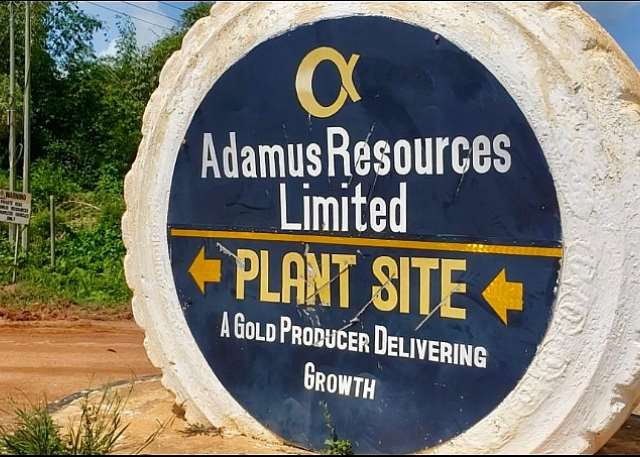
That is what made the recent dispute involving Adamus Resources particularly significant. Adamus Resources Limited is Ghanaian-owned. Yet the Ministry of Lands and Natural Resources confirmed the revocation of three mining leases held by the company following findings by the Minerals Commission.
Government raised serious allegations, including unauthorised mining activities, subcontracting without approval, operations without approved plans or valid permits, and other regulatory breaches. Adamus rejected the allegations and challenged the process leading to the revocation, arguing that principles of fairness and administrative justice had not been respected.
These allegations cannot be trivialised. Ghanaian ownership cannot become immunity from Ghanaian law. A Ghanaian flag painted on an excavator does not give that excavator permission to cross a regulatory boundary. Local ownership without compliance is not development.
But beyond the legal arguments emerged a larger question: What exactly is Ghana’s philosophy for building Ghanaian mining companies?
There is an old lesson in cultivation. When a young tree bends, the farmer does not immediately reach for the axe. He stakes it, prunes it and waters it. Not because crooked growth should be tolerated, but because the objective is to eventually produce a stronger tree.
Where regulatory breaches are legally remediable, the state should be able to deploy compliance directives, penalties, restructuring, stronger supervision and clearly defined timelines. Revocation must remain available where the law warrants it, but it should be the regulatory axe, not necessarily the regulatory first-aid kit.
A Welcome Presidential Intervention
It is against this background that the intervention by President John Dramani Mahama deserves commendation.
On August 21, 2026, the Presidency announced that Adamus Resources had been given a reprieve following a meeting involving the company, the Ministry of Lands and Natural Resources and the Minerals Commission.
Rather than allowing the dispute to harden into opposing positions, the President brought the parties to the table and asked them to develop a pathway towards resolving the challenges facing the mine.
Under the arrangement, Adamus is expected to present a 12-month roadmap for turning the mine around. It will include a six-member management team, comprising three representatives each from Adamus and government, to supervise the turnaround.
The roadmap will also address liabilities owed to the Ghana Revenue Authority, Minerals Income Investment Fund, financial institutions and suppliers. Importantly, the parties will explore injecting fresh capital by inviting additional partners to take equity in the operation. The roadmap is expected to be presented to the President within two weeks.
This is a significant show of leadership.
Leadership is not always demonstrated by choosing one side of a dispute. Sometimes, it is demonstrated by creating the table around which competing interests can find common ground.
The President’s intervention does not mean Adamus should escape accountability. If breaches are established, they must be remedied and appropriate sanctions applied. Neither should Ghanaian ownership become a shield against regulation.
What the intervention demonstrates is that accountability and corporate extinction do not necessarily have to mean the same thing.
There is wisdom in asking whether a Ghanaian company facing serious challenges can be restructured, recapitalised, supervised and restored to compliance before the final axe falls. For demonstrating that balance between enforcement and enterprise development, the President deserves commendation.
Building Ghanaian Champions
Large multinational mining companies were not built in a day. They became formidable institutions through decades of capital accumulation, acquisitions, mistakes, restructuring and technical learning. If Ghana wants globally competitive indigenous mining companies, it must also think in decades.
Government cannot simply hand Ghanaian businesses mineral assets and call that empowerment. It must create an ecosystem in which Ghanaian companies can acquire capital, technology, governance systems and technical expertise while being held to the standards expected of responsible mining companies.
The Adamus intervention therefore presents an opportunity to define what Ghanaianisation should mean.
It should not mean replacing every foreign company with a Ghanaian one. Neither should it mean protecting Ghanaian businesses regardless of performance. It should mean deliberately building Ghanaian enterprises capable of competing with the best while maintaining environmental, safety, financial and governance standards.
This debate becomes more important when placed alongside developments at Damang Mine and Gold Fields Tarkwa. At Damang, government chose a path that eventually saw the operation transition to the state, with Engineers & Planners, a Ghanaian-owned company, subsequently approved as the successful bidder for the mining lease. At Tarkwa, discussions continue over the renewal of Gold Fields’ mining leases.
Each situation has its peculiar circumstances. But investors rarely read government decisions individually. They read them together. Together, they become a signal.
Mining capital is patient, but it is not sentimental. Investors can model taxes, royalties and local-content requirements. What capital struggles to price is policy unpredictability.
Ghana therefore needs consistency: consistency in enforcing regulations, protecting legitimate investment and nurturing Ghanaian enterprises.
Foreign investment and indigenous enterprise should not be treated as opposing armies. Foreign capital can provide investment, expertise and technology. Ghanaian participation can deepen domestic value retention and build national capability. Government’s responsibility is to construct the bridge between them.
President Mahama’s intervention in the Adamus dispute is an encouraging attempt to build that bridge. If the turnaround succeeds, it could become an important example of how the State can combine firm regulation with pragmatic support for indigenous enterprise.
For more than a century, Ghana has exported gold. Perhaps the next chapter of our mining history should also be about exporting something else: Ghanaian mining companies.
Gold eventually runs out. Institutions endure.
And perhaps the true measure of Ghana’s mineral wealth will ultimately not be the number of ounces we extract from the earth, but the number of enduring Ghanaian enterprises we build above it.