


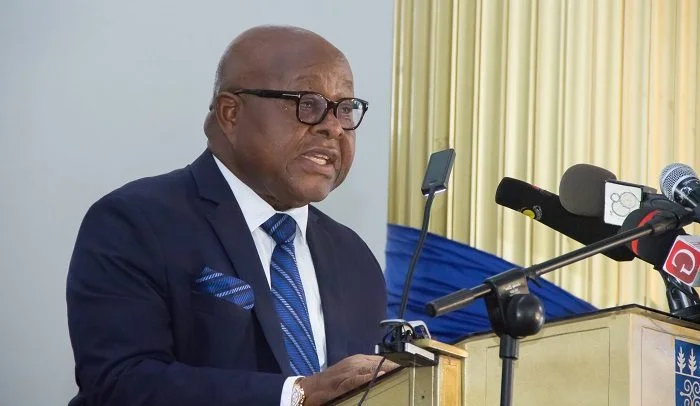
The Institute of Economic Affairs (IEA) has called on Ghana to take greater control of its mineral resources, arguing that the country cannot achieve sustainable economic development by relying primarily on royalties from foreign companies exploiting its natural resources.
Speaking on behalf of the IEA at the National Mining Dialogue 2026 organised by Semmis DS Group limited in collation with Ekosisen show of Asempa Fm in Accra, Professor Aaron Mike Oquaye said Ghana needed to fundamentally rethink its approach to mineral resource management and ensure that the country derived greater value from its vast mineral endowments.
He said Ghana’s resources, including gold, bauxite, diamond, manganese, iron, oil and gas, represented a critical foundation for the country’s future development, but warned that continuing to hand them over to foreign investors in exchange for royalties would perpetuate economic hardship.
“Gold, bauxite, diamond, manganese, iron, oil and gas. We from our research believe that is our future in this country. But if we will give it to others, foreigners, and then we will take royalties which we describe as rent, of course we are not going anywhere. And our children will continue to suffer,” Prof. Oquaye stated.
He argued that Ghana should seek to own a greater stake in its mineral products and engage foreign investors and technical experts where necessary rather than relinquishing control over the resources.
“If you own the product then the cost can also apply by-products. Because they are ours,” he said.
Prof. Oquaye cited Dubai as an example of a jurisdiction that has successfully leveraged ownership and control of its resources for national development, asking why Ghana could not pursue a similar model.
He further linked Ghana’s recurrent fiscal difficulties to the country’s failure to adequately harness its natural resources, noting that the country had resorted to the International Monetary Fund (IMF) on numerous occasions without resolving the underlying structural challenges.
“We have been to the IMF seventeen times through various regimes and all that has done us no good,” he said.
Prof. Oquaye also cited concerns about public expenditure and youth unemployment, referencing the Finance Minister’s observation that more than 44 per cent of tax revenue was being spent on public service salaries.
“It’s nobody’s fault but it tells us that there is something fundamental that we must examine,” he said.
He also questioned whether Ghana could sustain its current economic trajectory when a significant proportion of young people remained unemployed or outside meaningful economic activity.
On concerns that Ghana lacked the financial and technical capacity to take greater control of its mining industry, Prof. Oquaye disagreed, arguing that capital and expertise could be mobilised if mining projects were properly structured and managed.
“When you have the resource and there is shown that it’s a bankable project, of course you will get money from the international capital market,” he said.
He added that Ghanaian companies had developed considerable expertise in mining and that additional international expertise could be engaged where necessary.
Prof. Oquaye, however, identified political interference and weak management as major obstacles to effective exploitation of the country’s mineral resources.
He argued that management could be outsourced to competent professionals, including international experts, if necessary, to ensure that commercial considerations and national interests guided the management of the resources.
The IEA also called for a long-term, inter-generational approach to natural resource governance, emphasising that Ghana’s mineral wealth should not be treated as the property of the current generation alone.
“Those who are living, those who are here and those who are yet to be born. And all managers at any given time might be mindful of the fact that the land is not their own,” Prof. Oquaye stated.
He expressed concern that Ghana had failed to take full advantage of previous global economic transformations, including the Industrial Revolution, and warned against repeating the same mistake in the current knowledge and technological era.
“There have been industrial revolution. We have not been part of it as a nation. Today there’s the ICT revolution, the knowledge revolution etcetera. We are not part of it,” he said.
Prof. Oquaye further stressed the need to strengthen Ghanaian state-owned enterprises to enable the country to participate more effectively in the mining value chain.
He argued that the absence of strong and commercially viable state-owned enterprises had weakened Ghana’s ability to exercise meaningful ownership and control over its mineral resources.
“Today we don’t have serious [state-owned enterprises] so that… it is imperative for us to own the metal,” he said.
Prof. Oquaye said Ghana must therefore move beyond the traditional model of granting mining concessions and collecting royalties towards a system that promotes ownership, value addition, local participation and long-term national benefit.
“And we better take charge of our mines and other resources,” he stated.
He assured stakeholders that the IEA would continue to undertake research and contribute evidence-based proposals to the national conversation on mining and natural resource governance.
“We are researching and we will continue to research and feed our input into the process of the debate,” Prof. Oquaye said, while commending the organisers of the National Mining Dialogue 2026 for creating a platform for stakeholders to deliberate on the future of Ghana’s mining sector.
By: Christian/NR NEWS