


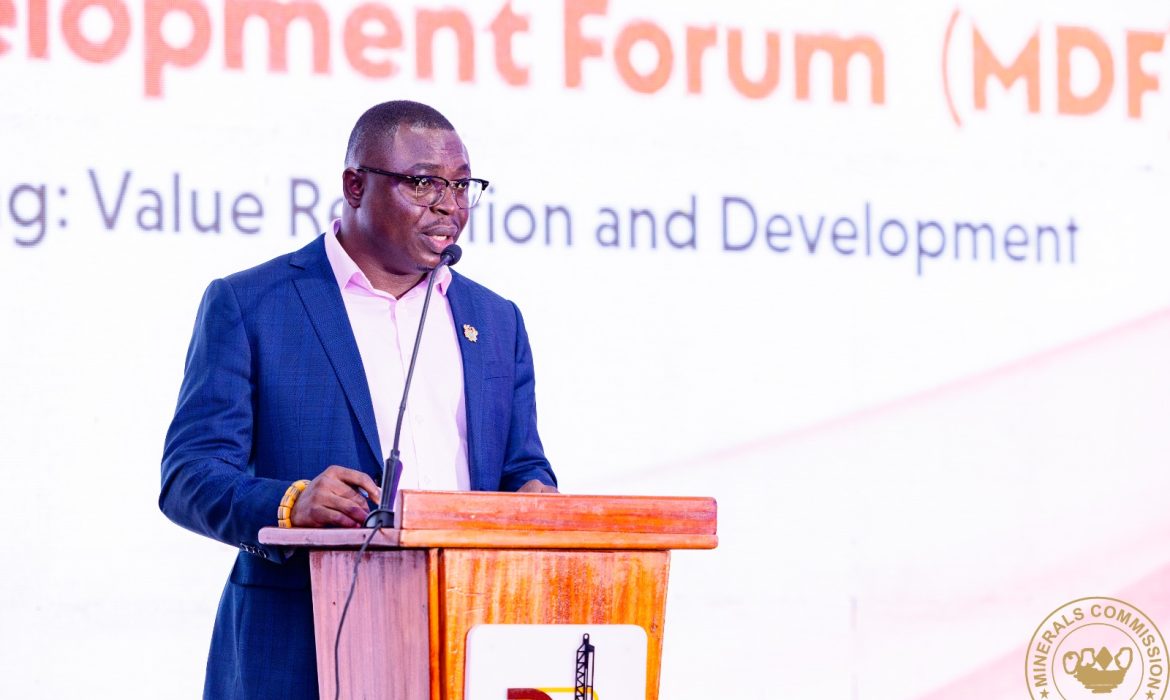
The Deputy Chief Executive Officer (Support Services) of the Minerals Commission, Emmanuel Anyimah, has reminded large-scale mining companies that a mining licence is a privilege and not an absolute right, urging them to strictly comply with the laws and conditions governing their operations.
Speaking at the National Mining Dilaogue 2026 organised by Semmis DS Group limited in collaboration with Asempa FM’s Ekosisen show, Mr Anyimah said mining companies must recognise that the mineral rights granted by the Republic of Ghana come with binding obligations and conditions that must be respected.
He said compliance with licence conditions was essential to ensuring that mining contributed meaningfully to national development while protecting communities, workers and the environment.
“A mineral right granted by the Republic of Ghana is a privilege, not an absolute right. It comes with binding conditions,” he said.
Mr Anyimah urged mining companies to comply fully with Ghanaian laws, their ratified mineral agreements, environmental permits and approved mine operating plans.
He cautioned that any deviation from approved operating plans must receive prior written approval from the Minerals Commission.
He further called on the companies to fulfil their reporting obligations, including the submission of monthly production returns, quarterly financial and operational reports, annual work programmes and audited accounts.
Compliance is non-negotiable
Mr Anyimah also emphasised the need for mining companies to prioritise health, safety and environmental protection, saying the industry must have zero tolerance for fatalities and avoidable incidents.
He urged companies to implement approved environmental management, mine closure and reclamation plans and adhere to standards prescribed by the Environmental Protection Agency and the Minerals Commission.
The Deputy CEO further reminded mining companies of their obligation to promptly pay royalties, mineral rights fees, ground rent and taxes.
He warned that companies that breached their licence conditions could face regulatory action, including notices, administrative fines, suspension or revocation of their licences.
“We prefer compliance through dialogue, but we will enforce the law where necessary,” the Commission said in the regulatory address.
Push for greater local participation
Mr Anyimah also called on large-scale mining companies to deepen local content and participation in their operations.
He said the objective of the Minerals and Mining (Local Content and Local Participation) Regulations, 2020 (L.I. 2431), was to maximise the value and benefits of Ghana’s mineral resources for Ghanaians.
He urged mining companies to give priority to qualified Ghanaians in employment, invest in skills development and apprenticeships, and establish partnerships with Ghanaian tertiary institutions.
They were also encouraged to increase procurement from Ghanaian businesses, promote joint ventures and facilitate technology transfer to enable local companies to move higher up the mining value chain.
Mr Anyimah said the Minerals Commission would also intensify monitoring of mining operations, with its Monitoring, Evaluation and Compliance Directorate scheduled to increase inspections and audits from the fourth quarter of 2026.
He therefore urged mining companies to engage the regulator early whenever they encountered operational or regulatory challenges rather than wait until enforcement action was taken.
He said responsible mining required respect for the law, people and the future, adding that compliance with licence conditions and L.I. 2431 would be critical to making mining a sustainable engine for jobs, industrial development and prosperity in Ghana.
By: Christian Kpesese/ NR NEWS