


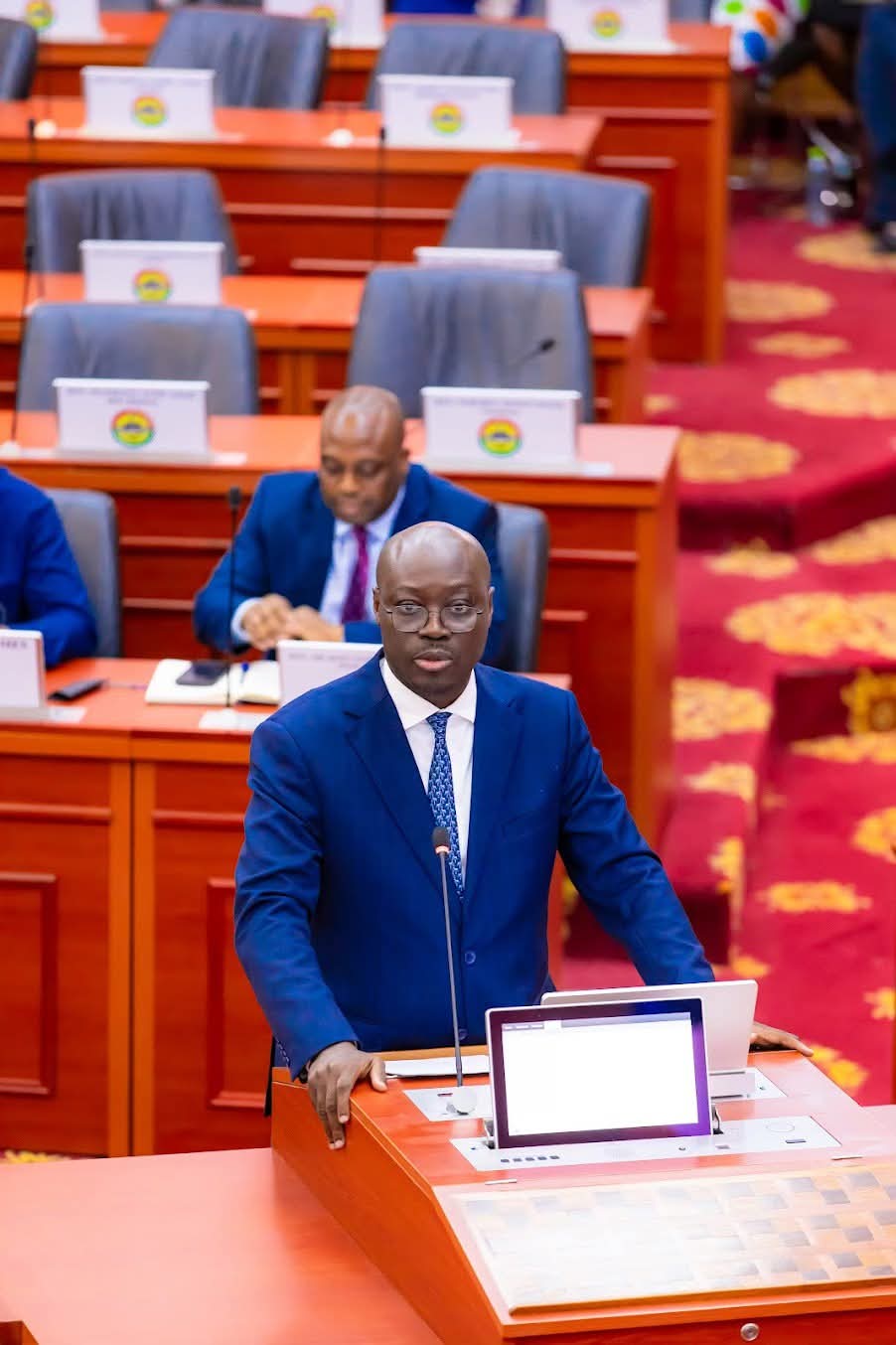
Ghana’s Minister for Finance, Dr Cassiel Ato Baah Forson, has announced what he described as a bold new economic direction for the country, declaring that Ghana will transition from economic stabilisation to long-term transformation under a new national programme dubbed “The New Economy” beginning in 2027.
Addressing Parliament in a statement on Thursday, May 28, 2026, Dr Forson, who is also the Member of Parliament for Ajumako Enyan Essiam, said Ghana had achieved significant macroeconomic recovery following years of fiscal distress.
According to the Finance Minister, Ghana has successfully concluded the final review of its IMF Extended Credit Facility (ECF) programme, pending formal approval by the IMF Executive Board.
He told Parliament that no further IMF financial bailout would be required in the foreseeable future, describing the development as a major turning point in Ghana’s economic history.
“Ghana has evolved from the position of supplicant to one of a partner with the International Monetary Fund,” Dr Forson declared.
The Finance Minister revealed that Ghana’s future engagement with the IMF would now shift to a non-financing Policy Coordination Instrument (PCI), a framework designed for countries seeking policy credibility and reform monitoring without direct financial assistance.
He explained that the PCI would provide Ghana with continued policy assessments and international validation to strengthen investor confidence and improve the country’s credit profile while allowing government to pursue reforms without depending on IMF funding.
“In other words, Ghana has moved from the intensive care unit to the wellness centre,” he stated.
Dr Forson used the statement to highlight what he described as remarkable improvements in Ghana’s macroeconomic indicators since the economic crisis of 2022.
He disclosed that the 91-day Treasury bill rate had dropped sharply from 28.4 per cent in January 2025 to 4.8 per cent by April 2026, while inflation had declined from levels above 50 per cent during the crisis period to 3.4 per cent in April 2026.
The Finance Minister also announced that Ghana recorded a current account surplus of 8.7 per cent of GDP as of December 2025, while the cedi appreciated by 40.7 per cent against the US dollar during 2025.
According to him, the country’s debt-to-GDP ratio had fallen to 44.7 per cent, while debt servicing pressures had reduced significantly.
He further stated that Ghana’s economy had crossed the 100 billion dollar mark, with non-oil GDP growth reaching 7.6 per cent — the highest level recorded in 14 years.
Dr Forson attributed the gains to what he described as strict fiscal discipline and structural reforms implemented under the administration of President John Dramani Mahama.
Among the measures cited were amendments to the Public Financial Management Act, expenditure controls, arrears audits, renegotiation of Independent Power Producer contracts, and the downsizing of government qlministries and ministerial appointments.
He said the government remained committed to enforcing fiscal rules and maintaining a policy of prudent spending.
“We can only spend what we have. Prudence is the difficult road to wealth creation,” the Minister emphasized.
Dr Forson also referenced President Mahama’s earlier declaration at the 77th Annual New Year School in January 2025 that Ghana’s current IMF programme should be the country’s final bailout arrangement.
“It is my hope that this would be the very last time we ever go for an IMF bailout programme,” the President had stated.
The Finance Minister said government’s next major focus would be the launch of “The New Economy” programme, expected to be fully unveiled in the 2027 Budget Statement.
According to him, the programme will shift the country’s attention from stabilisation measures to long-term economic transformation centred on job creation, industrial productivity, resilience and broad-based prosperity.
He said the initiative would serve as the foundation for a more self-reliant economy capable of sustaining growth without recurring external rescue programmes.
Dr Forson also thanked Ghanaians for what he described as their sacrifice, patience and resilience throughout the country’s difficult economic recovery period.
“Our solemn pledge is that we will not be complicit. We will continue the hard work of building the Ghana we want,” he said.
By: Christian Kpesese