


Ghana’s ambition to build a resilient industrial economy and sustain a 24-hour economy policy could be undermined by persistent power supply disruptions, the Association of Ghana Industries (AGI) has warned.
According to the Association, recent power outages have exposed deep vulnerabilities within the country’s manufacturing sector, increasing pressure on industries already battling high production costs and a difficult business environment.
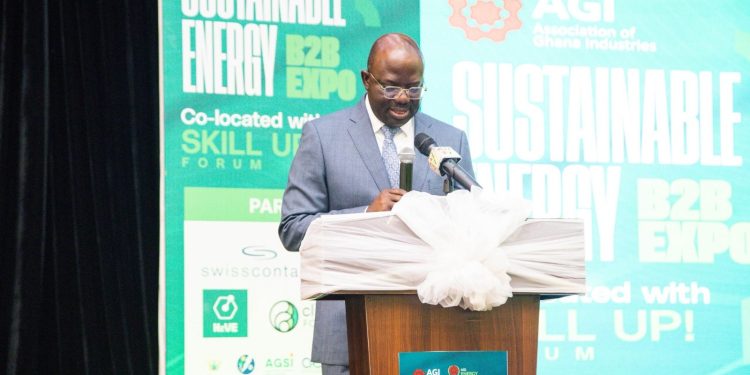
Addressing participants at the Sustainable Energy B2B Expo 2026 on the theme, “Powering Industry through Sustainable Energy,” the President of AGI, Kofi Nsiah-Poku, said reliable energy supply has become central to industrial growth, competitiveness and long-term investment decisions.
He stressed that energy challenges were no longer merely operational difficulties but a major structural threat to Ghana’s industrial transformation agenda.
“Energy remains the lifeblood of industrial growth. Without reliable, affordable and sustainable power, industries cannot expand and businesses cannot compete effectively,” he stated.
Dr. Nsiah-Poku warned that Ghana’s push towards industrialisation and a round-the-clock economy would remain difficult to achieve if businesses continue to experience unstable electricity supply.
“Ghana’s ambition of building a strong industrial economy and sustaining a 24-hour economy cannot be achieved without stable and uninterrupted power supply,” he cautioned.
The AGI President further noted that manufacturers are increasingly under pressure due to rising operational costs, global competition and growing sustainability demands from international markets.
He argued that sustainable energy must now form the backbone of Ghana’s industrial strategy rather than being treated as a peripheral development issue.
“Sustainable energy can no longer be treated as an alternative discussion on the sidelines of development. It must become central to our industrial strategy,” he added.
Dr. Nsiah-Poku highlighted the AGI Energy Service Centre as one of the Association’s practical interventions aimed at helping industries improve energy efficiency and integrate renewable energy solutions into their operations.
“It represents AGI’s commitment to helping industries transition into a future where sustainability and profitability work hand in hand,” he explained.
Also speaking at the event, Gunnar Wegner said the transition to renewable energy should be viewed as a competitiveness strategy for businesses rather than simply an environmental concern.
He likened renewable energy adoption to “moving into your own house,” explaining that companies investing in cleaner energy systems would be better protected from fuel price volatility and external shocks.
According to him, renewable energy and energy efficiency investments offer businesses both cost savings and long-term sustainability benefits, with the private sector expected to play a leading role in driving the transition.
The expo brought together stakeholders from industry, development institutions and the energy sector, including representatives from GIZ, Swisscontact, UN Global Compact Network Ghana, ClimateWorks Foundation and the Energy Commission.
Participants engaged in exhibitions, innovation discussions and networking sessions focused on sustainable energy solutions aimed at improving industrial efficiency and supporting Ghana’s long-term economic transformation agenda.