


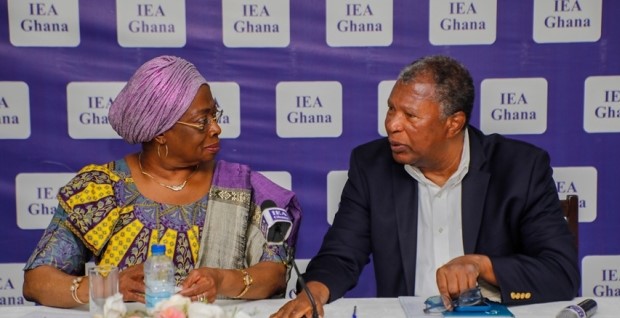
The Institute of Economic Affairs has intensified calls for the government to reject the proposed 20-year lease extension application by Gold Fields for the Tarkwa Mine, arguing that Ghana must use the opportunity to regain greater control over one of its most valuable mineral assets.
At a press conference in Accra on Wednesday, May 13, 2026, the policy think tank urged Parliament, traditional leaders, labour unions, civil society organisations and the general public to resist attempts to approve the extension of the mining lease, which is due to expire in April 2027.
Presenting the institute’s position, former Chief Justice and member of the Council of State, Sophia Akuffo, said Ghana’s long-term economic transformation depended on achieving genuine national ownership and stronger local participation in the extractive sector.
According to her, the expiration of the Tarkwa Mine lease presents a historic opportunity for the country to reclaim ownership and direct control over the mine in a way that ensures greater national benefit.
Justice Akuffo referenced recent comments by Gold Fields Chief Executive Officer, Mike Fraser, confirming that the company had formally applied for a lease extension and had begun engagements with government officials to secure approval.
She argued that despite more than three decades of large-scale mining operations in Tarkwa, many host communities continue to struggle with poor roads, inadequate schools and healthcare facilities, unemployment and environmental concerns.
The former Chief Justice noted that the Tarkwa Mine currently produces an estimated 500,000 ounces of gold annually, valued at more than US$2.3 billion at prevailing international gold prices, while contributing significantly to Gold Fields’ global production portfolio.
“The country must begin to ask whether the current structure of mineral exploitation is delivering the level of transformation and development expected by Ghanaians,” she stressed.
The IEA further rejected suggestions that Ghana lacks the technical expertise to manage major mining operations independently.
Justice Akuffo pointed to the contribution of the University of Mines and Technology in producing highly skilled Ghanaian mining engineers, geologists and industry professionals working both locally and internationally.
She noted that many large-scale mining operations in Ghana are already managed substantially by Ghanaians, while indigenous firms such as Engineers & Planners and Rocksure International execute major operational activities for multinational mining companies.
According to her, even several operational functions at Gold Fields’ Tarkwa Mine are presently undertaken by Ghanaian service providers.
Adding his voice to the debate, former Speaker of Parliament, Aaron Mike Oquaye, said Ghana must transition into an era where its natural resources directly support national development and economic independence.
He argued that continued foreign control of strategic mineral assets had contributed to persistent underdevelopment in mining communities and weakened the country’s ability to adequately finance critical sectors such as education, healthcare and social protection.
Prof. Oquaye proposed that foreign companies could still participate in the mining sector as technical service providers under strict national supervision rather than as concession holders with long-term control over mineral assets.
Board Chairman of the IEA, Charles Mensah, linked the debate to Ghana’s broader economic struggles, noting that the country has turned to the International Monetary Fund approximately 17 times over the past four decades.
He described the repeated IMF interventions as evidence of persistent structural weaknesses within the Ghanaian economy despite the country’s vast natural resource wealth.
Dr. Mensah stressed the need for deliberate policies aimed at building strong indigenous companies capable of participating competitively in large-scale mining and industrial ventures.
“We need to nurture local businesses to take advantage of major economic opportunities, create jobs and drive industrial growth,” he stated.
The Member of Parliament for Mpraeso, Davis Ansah Opoku, also backed calls for the government to reject the lease extension and explore models that promote stronger state participation and Ghanaian ownership in mining operations.
The debate over the future of the Tarkwa Mine lease has triggered wider national discussions about resource nationalism, local participation, foreign investment and the long-term management of Ghana’s mineral wealth.
The controversy also comes at a time of rising global gold prices and increasing pressure on African governments to secure greater economic value from natural resource extraction while maintaining investor confidence and sector competitiveness.