


The New Patriotic Party (NPP) Minority Caucus in Parliament has accused the Bank of Ghana (BoG) of understating its 2025 financial losses, insisting that the central bank’s true comprehensive loss stands at about GH¢44 billion rather than the GH¢15.6 billion publicly reported.
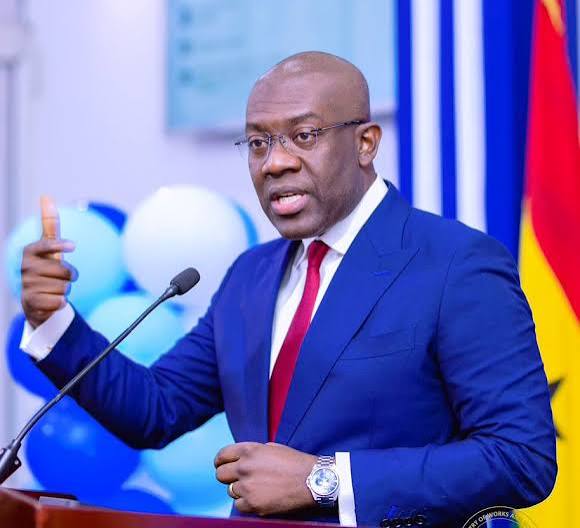
Addressing a press briefing on Sunday, May 2, 2026, Ranking Member of Parliament’s Economy and Development Committee and Member of Parliament for Ayirebi, Kojo Oppong Nkrumah, said the Minority’s analysis of BoG’s 2025 audited financial statements shows the bank is now “policy insolvent” for the first time in its history.
According to him, the central bank’s main income statement reports an operating loss of GH¢15.6 billion, while an additional GH¢19.3 billion loss is captured under “Other Comprehensive Income” in the consolidated financial statements.
The Minority argues that the separation of the losses across two statements effectively reduces the headline figure.
“When you combine the GH¢15.6bn operating loss with the GH¢19.3bn in other comprehensive income, you get GH¢34.9bn, which we round to GH¢35bn as the true operating loss for the Bank of Ghana alone,” Mr. Oppong Nkrumah said, adding that the figure for the entire BoG group stands at about GH¢35 billion.
The caucus further claims that about GH¢9.5 billion of the BoG’s reported GH¢22 billion operating income was derived from the sale of 50 percent of Ghana’s refined gold reserves in the last two months of 2025.
It argues that without this one-off transaction, core operating income would have stood at GH¢12.7 billion against sterilisation costs of GH¢16.7 billion, leaving a policy deficit of about GH¢4 billion.
“Adding the GH¢9.5bn gold sale back to the GH¢34.9bn loss gives us a true comprehensive loss of GH¢44 billion,” he stated.
The Minority also attributed part of the losses to policy reversals under the current BoG management.
It said the scrapping of the Dynamic Cash Reserve Ratio and the cedi-equivalent reserve requirement forced the central bank to rely heavily on interest-bearing open market operations to manage liquidity, pushing sterilisation costs from GH¢8.6 billion in 2024 to GH¢16.7 billion in 2025.
The caucus further criticised the restructuring of the Gold-for-Reserves programme, which shifted gold purchases to Ghana GoldBod.
According to the Minority, while BoG recorded about GH¢9 billion in losses from gold transactions, GoldBod posted roughly GH¢900 million in profits, resulting in a net national loss of approximately GH¢8.1 billion.
Mr. Oppong Nkrumah also questioned the accounting basis used in preparing the financial statements, referencing an emphasis in KPMG’s audit report on page 10 of the 2025 statements.
The report indicates that the consolidated financial statements were prepared under “the group’s own accounting policies” and “may not be suitable for any other purpose,” while BoG’s directors acknowledged on page 4 that full IFRS recognition and measurement criteria were not applied.
The Minority contends that this non-IFRS approach enabled the central bank to shift the GH¢19.3 billion loss out of the operating result, thereby masking the true scale of the deficit.
Beyond accounting concerns, the caucus linked BoG’s sterilisation policy to tightening credit conditions in the real economy.
It noted that the central bank paid GH¢14.6 billion in interest to commercial banks in 2025 for holding BoG bills, a development that coincided with a decline in private sector credit growth from 28.8 percent in 2024 to negative 13.9 percent in 2025.
“Banks earned risk-free interest instead of lending to SMEs and entrepreneurs,” Mr. Oppong Nkrumah said. “That GH¢14.6bn could have gone into classrooms, youth apprenticeships, or public-private partnerships.”
He also cited data from the Ghana Statistical Service indicating that youth unemployment rose from 30 percent to 34 percent in 2025, while raising concerns over delays in payments to cocoa farmers, teachers, nurses and teacher trainees.
The Minority further questioned the process leading to the release of the accounts, arguing that the National Democratic Congress (NDC) publicly announced the figures before the Finance Minister laid them before Parliament as required by law.
It said this contravenes Section 58 of the Bank of Ghana Act, 2002 (Act 612), which stipulates that the accounts must be submitted to the Minister of Finance before being gazetted and presented to Parliament.
Mr. Oppong Nkrumah also contrasted the NDC’s current defence of the central bank with its position in 2023, when it described BoG as a “crime scene” following a GH¢13 billion loss and declared it “bankrupt” at a time it was only nearing policy insolvency.
On the way forward, the Minority indicated that it will publish a set of reform proposals this week aimed at restoring the central bank’s financial health, with plans to submit the recommendations to the International Monetary Fund (IMF) for consideration in upcoming programme reviews.
“If nothing changes, BoG risks moving from policy insolvency to actual insolvency,” he warned.
By: Christian Kpesese