


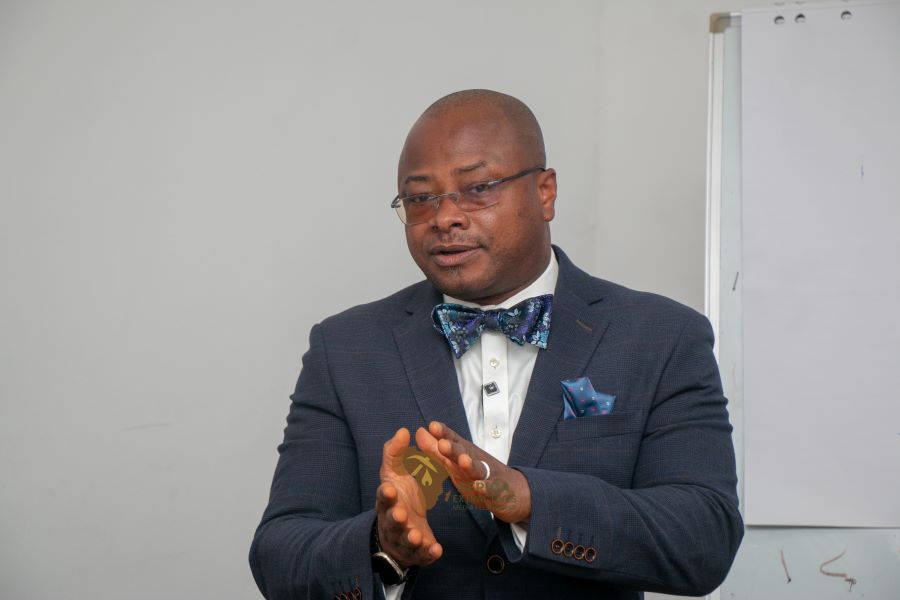
President of the Ghana Chamber of Mines, Michael Edem Akafia, has cautioned that poorly calibrated fiscal reforms could shrink Ghana’s mining industry and ultimately undermine government’s own revenue ambitions.
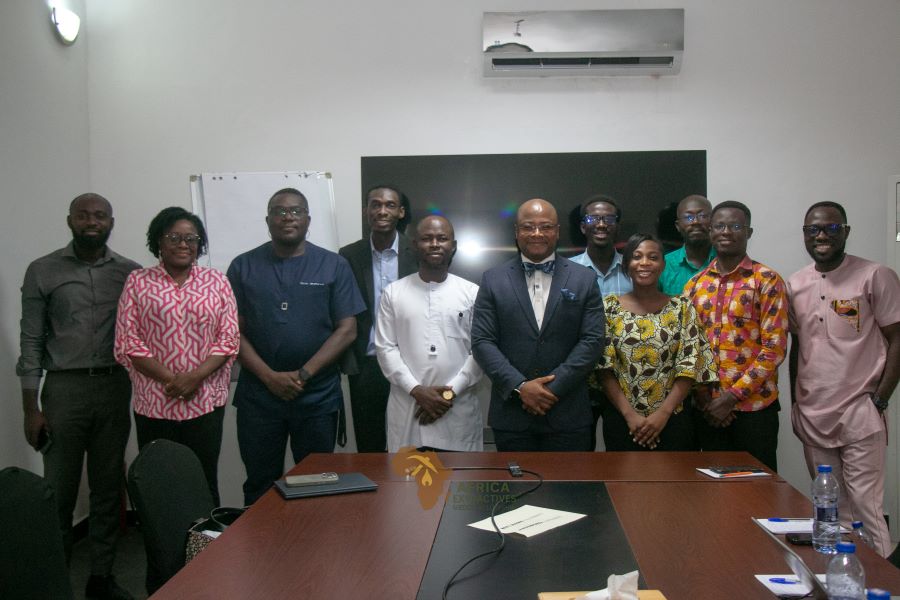
Speaking during an interaction with fellows of the first cohort of the Africa Extractives Media Fellowship (AEMF) organised by Newswire Africa, Mr. Akafia said while the industry appreciates government’s desire to respond to record gold prices, reforms must be carefully designed to avoid unintended consequences.
He disclosed that the Chamber recently met the sector minister, together with the finance minister, where proposed amendments to the mining fiscal regime were discussed. According to him, although government’s objective is fiscal consolidation and revenue optimisation, especially in difficult economic cycles, the approach must not sacrifice sustainability.
“Governments, particularly in times of high inflation or fiscal stress, look to the revenue side. Mining becomes an obvious target,” he noted. “But if these things aren’t done right, the industry will shrink and the revenue objectives won’t be met.”
At the heart of the debate is a proposed sliding scale royalty tied to gold prices. While Mr. Akafia said the Chamber is not opposed in principle to a sliding scale, he cautioned that the current proposal could effectively double royalties from 5 per cent to as high as 12 per cent at prevailing prices. When combined with the 3 per cent General Sales Levy (GSL), which is not tax-deductible, the effective burden could rise to 15 per cent on revenue.
He emphasized that royalties in Ghana are imposed on gross revenue, not profit, a structure he described as unusual and distortionary.
“Revenue is at the top of the income statement. When you impose 12 per cent on revenue, plus 3 per cent GSL, you are shrinking the entire pie before profit is even calculated. Even knowledgeable writers sometimes confuse revenue with profit,” he observed.
Mining projects, he explained, are capital-intensive and long-term, often taking between 13 and 20 years from greenfield exploration to production. They rely heavily on project finance, which is based on feasibility studies and fiscal assumptions. Sudden changes to the fiscal regime, he warned, could render previously viable projects unattractive to investors.
The Chamber of Mines President cited global examples where windfall taxes backfired, referencing experiences in Australia and Zambia, and urged Ghana to avoid measures that may discourage future investment.
“The objective should be to grow the economic pie sustainably,” he said. “If companies collapse or cancel projects, the state loses corporate income tax, employment taxes, VAT, and all the indirect benefits.”
Mr. Akafia added that the Chamber has submitted a position paper and remains hopeful that ongoing engagements with government will produce what he termed “a sweet spot” that balances revenue mobilisation with competitiveness.
“Our expectation is that government will appreciate where we are coming from,” he said. “Reducing growth and sustainability from 3 per cent to 1 per cent is not something we should rejoice about.”
The Africa Extractives Media Fellowship (AEMF), an initiative by NewsWire Africa in collaboration with the Australian High Commission in Ghana, aims to build a network of skilled journalists equipped to drive transparency, accountability, and informed public dialogue on the management of natural resources.
It emphasis on cross-sector collaboration, ethical storytelling, and data-driven reporting to reshape the continent’s natural resource governance narrative.
By: Christian Kpesese/www.naturalresourcesnews.com