


Ghana is preparing sweeping changes to the governance of its mining sector, with plans to decentralise licensing decisions, introduce a new class of mining permits and tighten enforcement against illegal activity, as part of a broader reset of natural resource management.
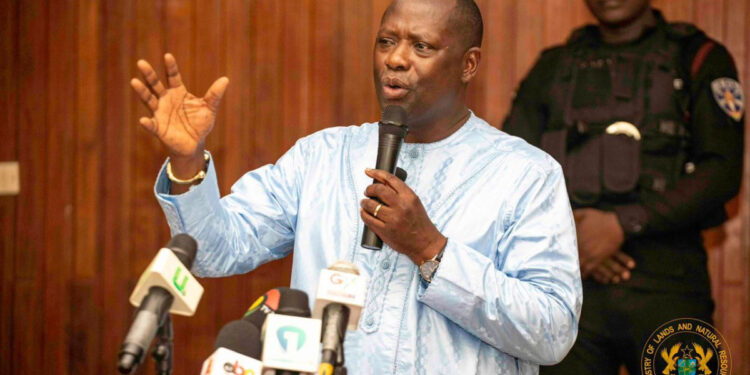
The Minister for Lands and Natural Resources, Emmanuel Armah-Kofi Buah, said the reforms—anchored in proposed amendments to the Minerals and Mining Act, 2006 (Act 703), are being finalised for Cabinet approval. The changes are intended to modernise Ghana’s mining framework in line with global best practice, while correcting weaknesses exposed over more than a decade of implementation.
Mr Buah outlined the proposals during a working visit by Vice-President Prof. Jane Naana Opoku-Agyemang to the ministry, as part of her familiarisation tour of key government departments amid the administration’s economic and governance reset agenda.
Bringing mining decisions closer to communities
At the heart of the proposed reforms is the establishment of District Mining Committees, designed to move decision-making closer to mining communities and reduce the concentration of licensing authority in Accra.
“For too long, licences have been issued in Accra without sufficient engagement with the people and authorities on the ground,” Mr Buah said. “We believe mining decisions must begin at the district level.”
Under the new system, prospective miners would first be required to engage district committees and traditional authorities before applications are forwarded to national regulators such as the Minerals Commission and the Environmental Protection Agency (EPA). Local bodies would assess whether proposed mining sites pose risks to water bodies, forest reserves or other environmentally sensitive areas, and make formal recommendations before licences are considered centrally.
The minister described the shift as a structural reform aimed at strengthening environmental safeguards and restoring public confidence in mining oversight.
New licence tier and tougher enforcement
Government also plans to introduce a medium-scale mining licence, creating a regulatory bridge between small-scale and large-scale operations. According to Mr Buah, the new licence category is intended to widen access to formal mining while encouraging operators with adequate capital and technical capacity to comply with environmental, safety and operational standards.
In a strong policy signal, the minister confirmed the revocation of Legislative Instrument 2462, reiterating the government’s ban on mining in forest reserves and water bodies.
“There will be no mining in forest reserves and no mining in water bodies,” he said. “We are determined to keep our waters blue and our forests green.”
Enforcement efforts have also been strengthened with the establishment of the National Anti-Illegal Mining Operations Secretariat (NAIMOS). The ministry reports that more than 255 small-scale mining licences have already been revoked, with additional reviews ongoing.
Land reforms and customary boundaries
Beyond mining, the Vice-President was briefed on efforts to overhaul land administration, including plans to establish Lands Commission offices in 110 metropolitan, municipal and district assemblies nationwide.
Mr Buah said the operationalisation of the Land Act—particularly provisions on the demarcation of land banks—was critical to addressing long-standing disputes and uncertainty. The ministry, working with the Lands Commission and the Office of the Administrator of Stool Lands, is demarcating customary land boundaries, a move seen as essential to reducing conflicts and improving investment certainty.
Prof. Opoku-Agyemang assured the minister of the government’s continued backing, while stressing that environmental protection is both a moral obligation and a national imperative. She also urged the ministry to deliberately consider women in customary land administration, which remains a major barrier to inclusive access to land.
“You are responsible for the environment, and that is a very weighty responsibility,” the Vice-President said. “Your work affects livelihoods, environmental outcomes and long-term development.”
A test for Ghana’s reset agenda
The visit comes amid heightened public scrutiny over illegal mining, environmental degradation and land tenure disputes. If effectively implemented, the proposed reforms would represent the most significant overhaul of Ghana’s mining governance in nearly two decades.
The challenge, however, will lie in execution. While decentralisation could strengthen accountability, observers note it will only succeed if local structures are adequately resourced and insulated from political interference. As the Vice-President’s visit underscored, Ghana’s reset will ultimately be judged not by policy ambition alone, but by enforcement on the ground.
Ghana Moves to Overhaul Mining Governance with Decentralised Licensing and Tougher Enforcement


- Advertisment -