


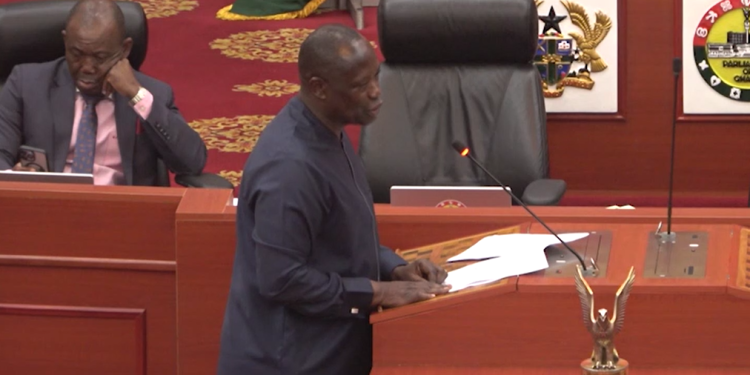
The Minister for Lands and Natural Resources, Emmanuel Armah-Kofi Buah, on Friday, December 19, 2026, laid before Parliament a new Minerals (Royalties) Pricing Schedule Regulation, introducing a sliding-scale royalty regime for gold, lithium and other minerals mined in Ghana.
The regulation, laid in accordance with Regulation 2(1) of the instrument, is intended to align Ghana’s mineral royalties with prevailing international market prices, ensure fairer returns to the state during periods of high commodity prices, and promote transparency in the determination of mineral values.
Under the new regime, gold royalties will no longer be charged at a flat rate but will vary depending on international prices.
Speaking to newsmen in Parliament, Minister Buag said, where the gold price is up to US$1,900 per ounce, a royalty rate of 5 per cent will apply.
He explained further that, the rate increases progressively to 6 per cent when prices rise above US$1,900 to US$2,000, 7 per cent for prices between US$2,000 and US$2,500, and 8 per cent for prices above US$2,500 to US$3,000.
The royalty rate climbs further to 9 per cent for prices above US$3,000 to US$3,500, 10 per cent between US$3,500 and US$4,000, 11 per cent between US$4,000 and US$4,500, and caps at 12 per cent when gold prices exceed US$4,500 per ounce.
According to him, the sliding-scale model has been introduced in the Ewoyaa lithium (spodumene), agreement with Barari DV which has been relayed before Parliament.
The sliding-scale model, the minister said reflects growing strategic importance in the global energy transition.
Accrding to the new sliding-scale Ghana’s lithium royalties will be charged at 5 per cent when prices are up to US$1,500 per tonne, rising to 7 per cent for prices between US$1,501 and US$2,500.
Additionally, where prices range from US$2,501 to US$3,000, a 10 per cent royalty will apply, increasing to 12 per cent when prices exceed US$3,000 per tonne.
For other minerals, including diamond, bauxite, manganese, salt, limestone, iron ore and other industrial minerals, the regulation maintains a uniform royalty rate of 5 per cent, preserving stability for producers in those sectors.
The regulation also clearly defines how mineral prices are to be determined for royalty purposes. In the case of gold, royalties will be calculated using the weekly average London PM Fix Price published by the London Bullion Market Association (LBMA) for the month in which sales occur.
Where the LBMA PM Fix ceases to exist, the regulation allows parties to mutually agree on an alternative internationally recognised market index.
For lithium (spodumene) and other minerals, the market value will be determined on an arm’s-length basis, taking into account prevailing international market prices, a move aimed at reducing under-declaration and improving state revenue mobilisation from the extractive sector.
Mr Emmanuel Armah-Kofi Buah said the new pricing framework reflects government’s broader policy of ensuring that Ghana derives maximum value from its natural resources, particularly during commodity price booms, while remaining competitive and predictable for investors.
The regulation is expected to come into force after the mandatory 21 sitting days of parliament, unless rejected by the House.
By: Christian Kpesese