


The Minister for Lands and Natural Resources, Emmanuel Armah-Kofi Buah, has justified government’s decision to withdraw and renegotiate Ghana’s lithium agreement, saying the revised deal is significantly stronger, more transparent and better positioned to protect the national interest.
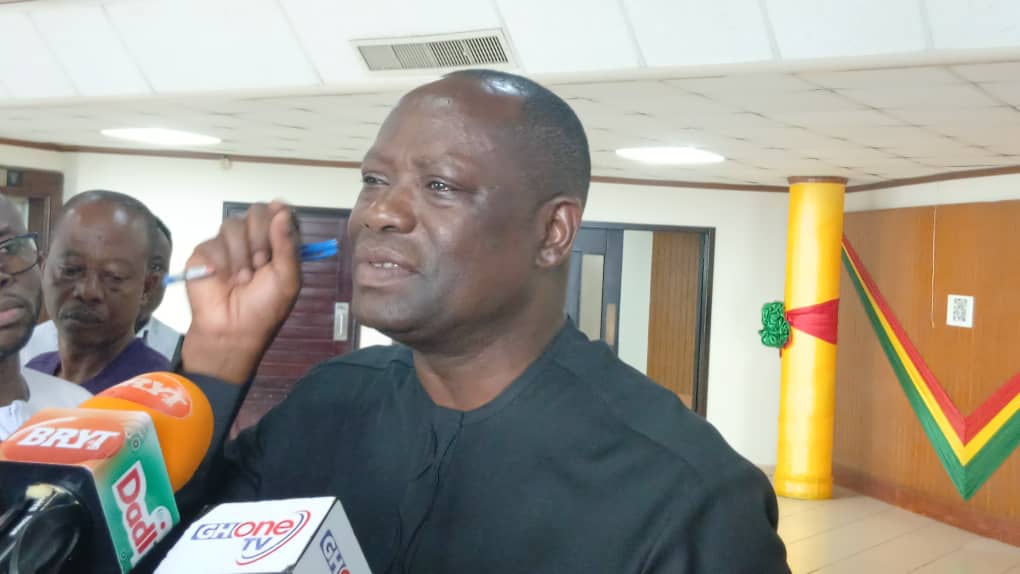
Addressing a press conference after laying the enhanced lithium agreement and accompanying regulations before Parliament, Mr Buah said the new framework was the product of extensive consultations with key stakeholders, including local communities and civil society organisations.
“I’ve come back to Parliament to lay a very enhanced, strengthened lithium agreement, and that was achieved by consultations with key stakeholders, including visits to the communities in Mankessim and Awoyaa,” he said. “We listened to civil society organisations and other stakeholders, and it became very clear that we had a challenge.”
According to the Minister, the decision to withdraw the earlier lithium agreement demonstrated responsive leadership.
“This is what good leadership is about,” he stated. “Having listened to all of them, we made the decision that we needed to withdraw the lithium agreement so we could strengthen it. Today, I’m happy that I came back to Parliament not only with the lithium agreement, but with elaborate regulations on lithium.”
Mr Buah explained that Ghana’s royalty regime, particularly for lithium, had evolved inconsistently over the years, creating gaps in implementation. He traced the history from earlier fixed royalty arrangements to subsequent amendments that required royalties to be “prescribed by law” without providing a clear legal framework for that prescription.
“Unfortunately, there was no prescription,” he said. “So the guidelines to determine whether in this negotiation the royalty should be three to five percent or five percent were not in place.”
He noted that in the absence of a clear legal framework, negotiators were constrained to stick to the existing flat rate, even when market conditions justified higher state benefits.
To address this, the Minister said government has now introduced a comprehensive regulation that establishes a sliding-scale royalty regime across the minerals sector, including lithium.
“The advantage is that it allows the state to capture the benefit in good times, like in the gold sector,” he explained. “When prices go up, the government takes advantage and captures the benefit. When prices tumble, the adjustment automatically favours lower royalties for the companies.”
Using lithium as an example, Mr Buah said the earlier agreement was negotiated when prices were around US$3,000 per tonne, yielding a 10 per cent royalty. Under the new sliding-scale arrangement, government could still achieve a 10 per cent royalty even if prices fall to US$2,500, and up to 12 per cent when prices exceed US$3,000.
“If you do the calculation, at that point it means government is saving almost over US$500 million,” he said.
Beyond royalties, the Minister said the revised lithium agreement introduces new provisions that were absent in the 2023 deal, including explicit infrastructure obligations and a dedicated community development fund.
“For the first time, we have a one per cent community development fund that will transform the Effutu and Infanciman communities,” he announced. “This is a model I am going to push in all agreements.”
He explained that the fund, set at one per cent of gross revenue, would be dedicated solely to host communities and used to finance projects such as roads and hospitals, independent of central government allocations.
“Think about it,” Mr Buah said. “One per cent of gross revenue going directly to the community. That is real transformation.”
The Minister expressed confidence that the enhanced agreement strikes a fair balance between protecting Ghana’s interests and providing certainty to investors, insisting that the new framework makes Ghana a more predictable and attractive destination for responsible mining investment.
By: Christian Kpesese/ NR NEWS