


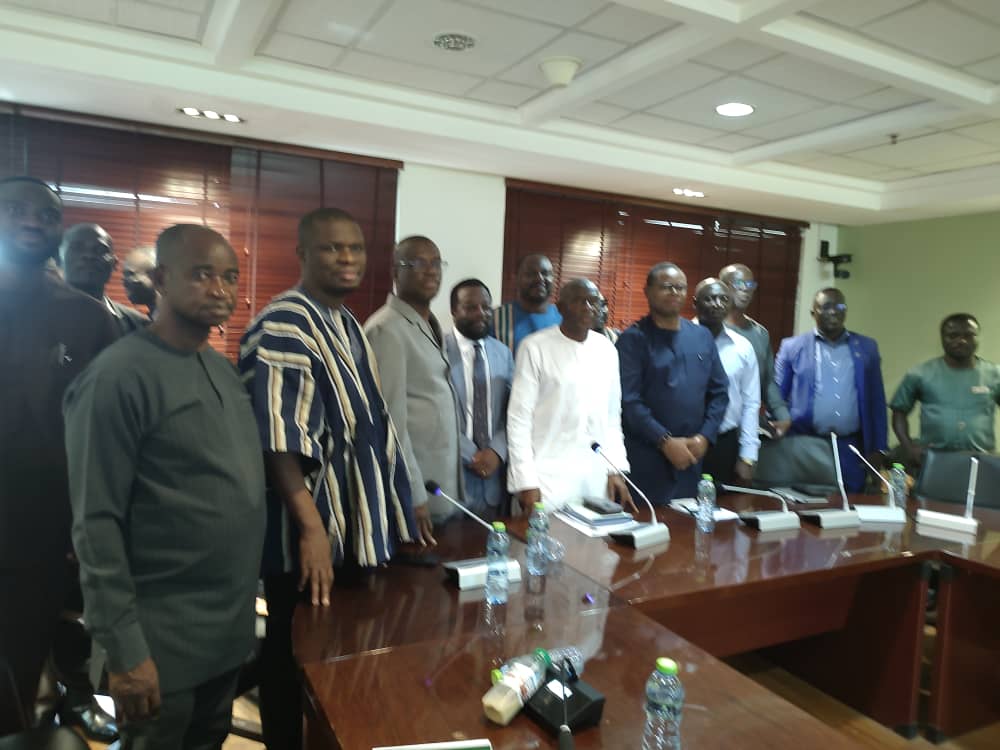
IMANI Africa has renewed its call for Parliament to reject the proposed 2025 Ewoyaa Mining Lease in its current form, insisting that the royalty rate must not fall below 10 percent. The policy think tank, led by its President, Franklin Cudjoe, reiterated this position when it appeared before the Parliamentary Select Committee on Lands and Natural Resources on Thursday, December 11, 2025.
The appearance formed part of the Committee’s scheduled stakeholder engagement on the revised mining lease for Barari DV Ghana Limited before its latest withdrawal by the sector ministry for wider consultation at government level.
Chairman of the Committee, Alhaji Collins Dauda, commended IMANI for its consistent dedication to promoting good governance in Ghana’s extractive sector and for submitting technically grounded analyses on the Ewoyaa project to date.
IMANI’s Central Recommendation: Parliament Should Not Ratify the Lease in Its Current Form
Citing extensive economic modelling and legal analysis, IMANI told the Committee that Ghana stands “on the verge of undermining its own strategic mineral wealth” by accepting a royalty regime that sharply reverses gains made in the 2023 version of the agreement.
The 2023 lease set a 10% royalty and 13% state carried interest celebrated then as a significant departure from Ghana’s historical “low-value” concessions. However, the updated 2025 version defers the royalty rate to what is “prescribed by law,” effectively defaulting to 5%, a revision IMANI describes as a “catastrophic concession” that cannot be justified by market conditions or legal constraints.
IMANI insisted that Parliament must restore the 10% baseline or replace it with a sliding-scale royalty tied to market prices to safeguard Ghana’s long-term revenue prospects.
Economic Analysis Undermines Government’s Justification
The Ministry of Lands and Natural Resources has argued publicly that global lithium prices have plummeted, making a 10% royalty unsustainable. But IMANI dismissed this reasoning as “economically unfounded,” demonstrating from the company’s own Definitive Feasibility Study (DFS) that the Ewoyaa project remains highly profitable even at conservative price assumptions.
The DFS shows an All-In Sustaining Cost (AISC) of US$610 per tonne, while current market prices are above US$1,170 per tonne, generating substantial margins that can comfortably support a 10% royalty.
Even under “crisis pricing” scenarios, IMANI’s modelling shows the project remains profitable. At current prices, reducing the royalty from 10% to 5% transfers about US$21 million annually from Ghana to the company — a figure expected to rise significantly during future commodity upcycles.
“No Legal Barrier to a 10% Royalty” — IMANI Refutes Majority’s Claims
IMANI also challenged the Majority Caucus’ claim that a 10% royalty would violate the Minerals and Mining Act, which they argue caps royalties at 5%.
The think tank described this legal argument as a “serious misinterpretation,” explaining that:
The 2015 amendment to the Act empowers the Minister to prescribe royalty rates through regulation.
More importantly, article 268 of the Constitution gives Parliament full authority to ratify agreements that differ from general law, effectively giving such agreements the force of law once approved.
“Using administrative inaction as a justification for fiscal retreat is unacceptable,” IMANI told the Committee.
Concerns Over Weakened Value Addition and New Jetty Proposal
IMANI’s brief also warned Parliament that the 2025 lease dilutes obligations on local value addition. While the 2023 agreement required the establishment of a chemical plant subject to feasibility, the 2025 version softens this into a mere “scoping study,” creating an “escape route” for the operator to avoid establishing a refinery.
The think tank further dismissed the newly introduced proposal for a Saltpond jetty as technically unrealistic due to bathymetric and coastal conditions. It argued the clause appears more political than practical and risks becoming a costly distraction that does not compensate for lost revenue through lower royalties.
The think tank recommended that Parliament should:
Restore the 10% royalty or adopt a sliding scale
Replace the scoping study with a binding refinery commitment supported by a definitive feasibility study
Order an independent audit of the Saltpond jetty proposal
Clarify the royalty rate in the lease itself to avoid future administrative dilution
Ensure community funds are managed transparently through an independent trust
Committee’s Response
Committee Chair Alhaji Collins Dauda thanked the IMANI delegation for its intervention and assured them that the Committee would deliberate thoroughly on the concerns raised to safeguard the national interest when the agreement is reintroduced.
As Parliament awaits the return of the Ewoyaa Mining Lease, IMANI’s appearance is expected to sharpen national attention on what could become Ghana’s most consequential mineral agreement since the advent of commercial gold mining.
By: Christian Kpesese