


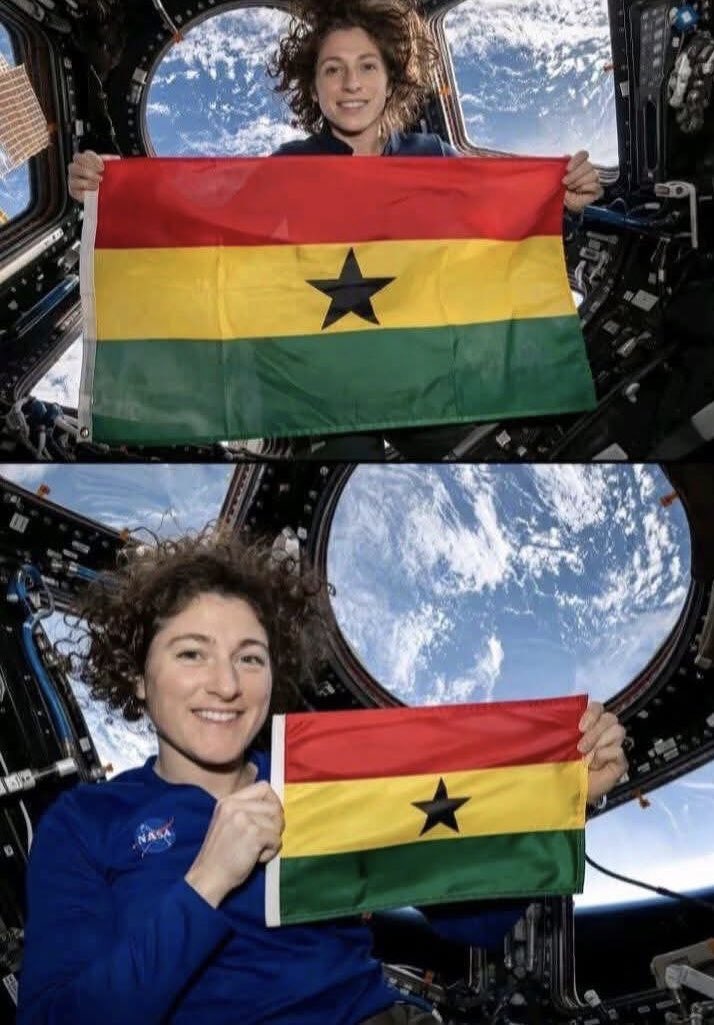
On April 1, 2026, a group of astronauts began a historic journey around the Moon—the first crewed mission of its kind since the era of the Apollo program.
The mission, known as Artemis II, marked a defining moment in humanity’s return to deep space exploration and a renewed push toward sustained presence beyond Earth.
Among the four-member crew was Christina Koch, the only woman on board, alongside NASA astronauts Reid Wiseman, Victor Glover, and Canadian Space Agency astronaut Jeremy Hansen. Together, they embarked on a 10-day voyage that would carry them farther into space—around the Moon—than any human has traveled in over 50 years, since the last lunar mission in 1972.
But beyond the scientific achievement and technological precision, Christina Koch’s presence on this mission holds a unique significance for Ghana. Long before her journey into space, she spent a formative period at the University of Ghana as an exchange student during the 1999/2000 academic year.
That experience, rooted in Ghanaian education and culture, now places Ghana within the broader narrative of one of the most important space missions of our time. Her studies in Ghanaian and African history, rural sociology, music, and introductory Twi were more than academic pursuits—they were part of a deeper cultural immersion that shaped her worldview and reinforced the value of global citizenship.
As the Artemis II mission unfolded, it demonstrated not only human endurance but also technological resilience. The crew successfully navigated the harsh conditions of deep space, including surviving extreme temperatures of up to 5,000 degrees Fahrenheit during re-entry into Earth’s atmosphere. These conditions tested the spacecraft’s systems to their limits, validating critical technologies designed for future missions.
At exactly 8:07 p.m. Eastern Daylight Time on April 10, 2026, the crew safely splashed down in the Pacific Ocean near San Diego, California, bringing their historic 10-day mission to a successful conclusion. This safe return marked a major milestone, confirming that the spacecraft systems are ready for the next phase of lunar exploration—the anticipated Artemis III mission, which aims to land humans on the Moon once again.
For Ghana, however, the significance of this mission goes far beyond science and engineering. It is about global identity, influence, and recognition among the community of nations.
Christina Koch’s journey brings into focus the role Ghana plays in shaping individuals who go on to achieve global impact. It highlights the strength of Ghana’s educational institutions, particularly the University of Ghana, as centers of intellectual and cultural development that resonate far beyond national borders.
Within the international arena, this connection enhances Ghana’s profile as a country that contributes meaningfully to global progress—not only through direct participation but through the people it influences and the experiences it provides.
It also reinforces Ghana’s reputation for hospitality. The fact that an astronaut of such global stature continues to acknowledge her time in Ghana, and symbolically carried the Ghanaian flag into space, speaks volumes about the lasting impression the country leaves on its visitors. This is the essence of Ghana’s soft power, its ability to build enduring relationships through culture, warmth, and openness.
In terms of tourism, this moment presents a compelling narrative for Ghana on the world stage. It positions the country as more than a destination of historical significance—it becomes a place where global journeys begin, where individuals are shaped, and where experiences have lifelong impact. The story of a student who once studied in Accra and later journeyed around the Moon is both powerful and marketable, capable of attracting global attention and curiosity.
For Ghana’s youth, the implications are equally profound. Christina Koch’s story demonstrates that the foundations for extraordinary achievement can be built within Ghana’s own institutions. It challenges young people to see themselves as part of a global future, to embrace education, and to pursue excellence with determination.
At a policy level, this moment underscores the importance of investing in education and strengthening international exchange programmes. It highlights the need to position Ghana as a hub for global learning and collaboration, where ideas are exchanged and futures are shaped.
National recognition of this achievement has also been evident, with President John Dramani Mahama expressing pride in Christina Koch’s accomplishment and Ghana’s role in her journey. His message reflects a broader national sentiment—one that sees in this mission a reflection of Ghana’s global relevance and potential.
As the Artemis II mission concludes and paves the way for Artemis III, Ghana’s place in this unfolding story becomes clearer. It is a place defined not by proximity to space technology, but by contribution to human development, cultural exchange, and global inspiration.
From the lecture halls of Legon to the vast frontier of space, Ghana’s imprint is evident—subtle yet significant.
And as humanity prepares for the next giant leap back to the Moon, Ghana can take pride in knowing that its influence, carried through one of the mission’s astronauts, has reached beyond the Earth and into history.
By: Christian Kpesese/ www.naturalresourcesnews.com