


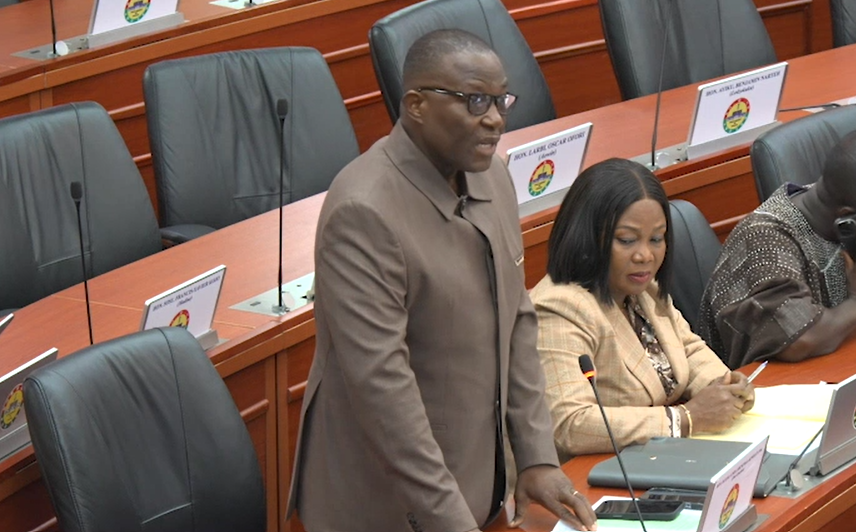
The Member of Parliament for Kpando, Sebastian Deh, has proposed the establishment of a dedicated Agricultural Finance Support Fund to expand access to affordable credit for smallholder farmers and accelerate the growth of Ghana’s agricultural sector.
Delivering a statement on the floor of Parliament on Thursday, 2026 Mr. Deh said improving financial inclusion for farmers is essential to boosting productivity, strengthening rural economies and ensuring national food security.
According to him, agriculture remains one of the most important sectors of the Ghanaian economy, employing more than half of the country’s workforce and contributing significantly to national output.
He noted that smallholder farmers constitute about 70 percent of Ghana’s farming population, producing the majority of staple foods such as maize, cassava, yam and vegetables.
Despite their critical role in sustaining the country’s food system, the MP said many farmers remain among the most economically vulnerable groups in society due to limited access to financial services.
He explained that without affordable loans, savings products and insurance services, farmers are often unable to invest in improved seeds, fertilizers, mechanisation, irrigation systems and post-harvest infrastructure.
“Access to finance remains one of the biggest barriers to the growth and prosperity of smallholder farmers,” Mr. Deh told the House.
Citing the 2021 Global Findex Report, he said many rural populations in Ghana remain underserved by formal financial institutions, a situation that continues to limit agricultural productivity and deepen rural poverty.
To address the challenge, Mr. Deh proposed the creation of a national Agricultural Finance Support Fund that would provide credit guarantees to financial institutions lending to smallholder farmers.
According to him, such a fund would reduce the perceived risk associated with agricultural lending and encourage banks and other financial institutions to design low-interest and flexible loan products tailored specifically to farmers.
The Kpando MP acknowledged the work already being done by the Ghana Incentive-Based Risk Sharing System for Agricultural Lending, which provides risk-sharing mechanisms to encourage financial institutions to invest in agriculture.
However, he stressed that scaling similar initiatives through a dedicated national fund would significantly increase the volume of financing available to farmers across the country.
Beyond the proposed fund, Mr. Deh outlined additional policy measures aimed at strengthening financial inclusion within the agricultural sector.
One of the key recommendations he made was the expansion of digital financial services to rural communities.
He explained that the rapid growth of mobile money in Ghana provides an opportunity for financial institutions to develop mobile-based savings, credit and insurance products that can reach farmers in remote areas.
The MP also called for the creation of a national database of smallholder farmers, which would capture information such as crop types, farm sizes and production history.
Such a system, he said, would enable financial institutions to better assess creditworthiness and design customised financial products for farmers while reducing the risk premium often associated with agricultural lending.
Mr. Deh further emphasised the need for stronger public-private partnerships involving government agencies, financial institutions, agribusinesses and development organisations to deliver integrated support to farmers.
These partnerships, he explained, should combine financing with extension services, farm inputs, technical training and market access.
The MP also highlighted the growing threat posed by climate change to agricultural production and urged policymakers to promote climate-smart agricultural financing, including subsidised loans for climate-resilient seeds, irrigation systems and renewable energy technologies such as solar-powered equipment.
Mr. Deh stressed that women and young people must also be prioritised in agricultural financing policies.
He noted that women constitute a large proportion of smallholder farmers in Ghana but often face greater barriers to accessing credit and financial services.
Creating gender-sensitive financial products and innovative youth financing models, he said, would help unlock the full potential of the agricultural sector.
“Supporting smallholder farmers is not just an agricultural policy matter—it is a national development imperative,” he stated.
According to him, improving farmers’ access to finance, training and markets will strengthen rural livelihoods, enhance food security and contribute significantly to Ghana’s long-term economic development.
By: Christian Kpesese