


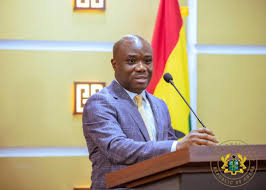
The Presidential Spokesperson and Minister for Government Communications, Mr Felix Ofosu Kwakye, has disclosed that the National Democratic Congress (NDC) government inherited what he described as “monumental and mammoth” debts in the energy sector, estimated at about GH¢80 billion.
Mr Ofosu Kwakye, who is also the Member of Parliament for Abura Asebu Kwamankese, made this known on Wednesday January 14, 2026 when he took his turn at the Government’s Accountability Series held at the Jubilee House in Accra.
He recalled that President John Dramani Mahama, in his first State of the Nation Address, highlighted the precarious state of the energy sector, particularly the scale of liabilities owed to various stakeholders, including state-owned entities.
“We inherited monumental mammoth debts in the energy sector. Up to about GH¢80 billion was owed to various players, including some state entities,” he said.
According to him, the government’s approach since assuming office has been to liquidate as much of the debt as possible within the period, noting that although some obligations may still remain, the commitment to settle substantial portions of the arrears remains firm.
“The commitment that the government and the Finance Minister have shown to pay substantial amounts will continue this year, and more payments will be made,” he assured.
Mr Ofosu Kwakye further explained that the challenges confronting the sector are compounded by a persistent energy sector financing shortfall, where the cost of generating electricity far exceeds the revenue collected from tariffs paid by consumers.
“If you break it down, the amount of money it costs to generate electricity is far more than what is collected. Even though electricity tariffs may appear high, they still do not reflect the full cost of generation due to inefficiencies and other structural challenges,” he explained.
As a result, government has had to intervene annually to bridge the gap. He revealed that in 2025, government paid GH¢27 billion to the energy sector to meet the shortfall, while an additional GH¢15 billion has been allocated this year following adjustments aimed at improving efficiency.
“When you put GH¢27 billion together with GH¢15 billion, that is GH¢42 billion. You can imagine what that amount could have done in other sectors, but we had to commit it to the energy sector to keep the system running,” he noted.
Mr Ofosu Kwakye said these realities informed government’s decision, announced in the 2026 Budget, to establish up to 1,200 megawatts of additional generation capacity to help reduce the cost of power production.
“The intention is to reduce the cost of generating power so that it becomes cheaper for consumers and to eliminate the need for continuous public funding to support the sector, which is not sustainable in the long run,” he said.
He also pointed to ongoing reforms to restore financial discipline within utility companies, particularly the Electricity Company of Ghana (ECG). According to him, government uncovered significant budget overruns and procurement irregularities upon assuming office.
“There was a year, 2024, when ECG budgeted about GH¢800 million for procurement, yet we discovered that it had spent up to GH¢7 billion, overshooting the budget by hundreds of percentage points,” he revealed.
Mr Ofosu Kwakye said some of the equipment procured would not be required for up to 15 years, describing the situation as unsustainable. He noted that such practices have since been halted.
“All of that has been nipped in the bud. The Energy Minister is now stamping his authority to ensure ECG and other utility companies adhere strictly to approved budgets and exhibit financial discipline,” he stated.
He emphasised that the measures being implemented are aimed at building a resilient, efficient and fit-for-purpose energy sector capable of meeting the needs of Ghanaians without imposing an unsustainable burden on public finances.
By: Christian Kpesese