


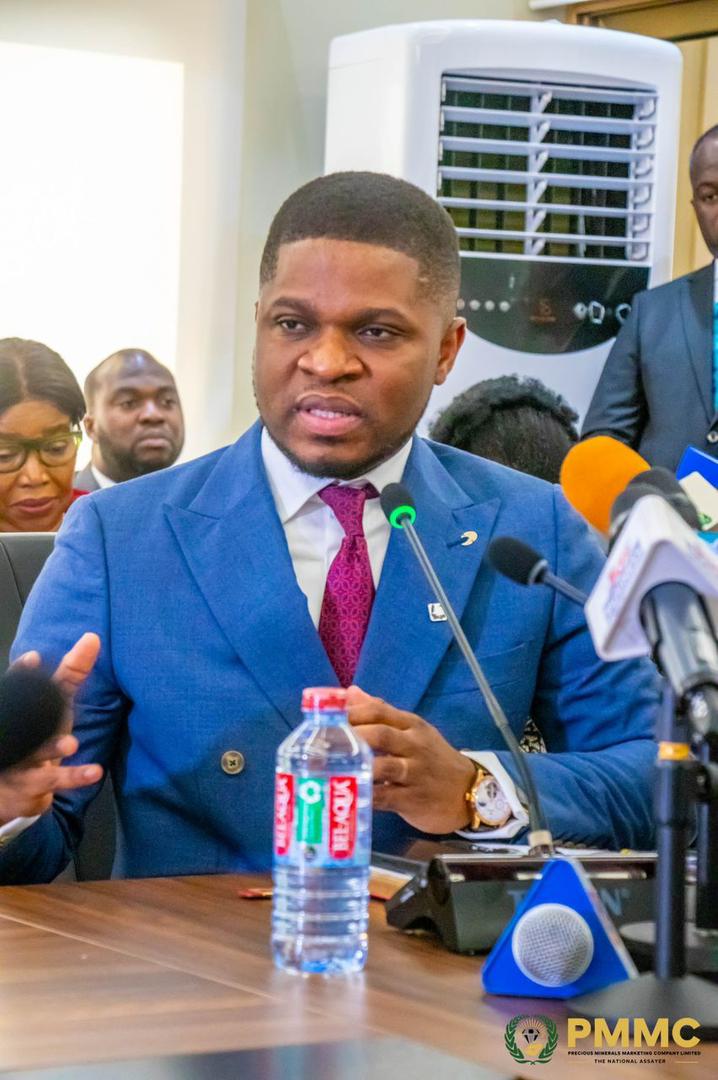
The Chief Executive Officer of the Ghana Gold Board (GoldBod), Sammy Gyamfi, has dismissed claims that losses linked to the Bank of Ghana’s gold purchasing programme stem from mismanagement, insisting that more than 97 per cent of the reported figures are the result of exchange rate translation.
Speaking during a panel discussion on Joy FM’s Newsfile programme on Saturday, January 3, 2026 as monitored by NR NEWS, Mr Gyamfi said the so-called losses arise from accounting treatment rather than any operational failures by either the Bank of Ghana or GoldBod.
He explained that gold purchases are conducted at prevailing market exchange rates applicable to non-bank transactions, but accountants later translate the foreign exchange component using Bank of Ghana rates, creating exchange rate differentials that are recorded as losses.
“We have explained that the bulk of this cost, which people are calling losses—over 97 per cent—comes from exchange rate translation differentials. We buy gold at market exchange rates, but the foreign exchange purchases are later converted at Bank of Ghana rates,” he said.
Mr Gyamfi was responding to claims that GoldBod had incurred significant losses which were subsequently passed onto the Bank of Ghana’s books. He rejected those claims, emphasizing that GoldBod has not recorded any losses since its establishment in April 2025.
According to him, GoldBod is on track to declare a surplus of between GH¢700 million and GH¢800 million for 2025. He said the institution generated revenue of slightly over GH¢960 million in 2025, while expenditure for the same period was below GH¢120 million.
Mr Gyamfi clarified that, as a public corporation, GoldBod does not declare profits but records a surplus, noting the distinction between commercial profit-making entities and state institutions.
“When you hear people talking about GoldBod losses, maybe they are dreaming or hallucinating. We have not made any losses. These are imaginary,” he said.
On the Gold for Reserves programme, Mr Gyamfi said it was not initiated by GoldBod but by the Bank of Ghana as a monetary policy programme in 2022—two years before GoldBod was created. He noted that the programme has always been funded and accounted for by the central bank, including in 2022, 2023 and 2024, when the New Patriotic Party was in government.
He added that any reported losses under the Gold for Reserves programme were linked to the design of the policy, which was aimed at supporting price stability, rather than poor management at the Bank of Ghana.
Defending GoldBod’s gold buying strategy, Mr Gyamfi said the decision to buy gold above prevailing prices was deliberate and intended to curb smuggling. He recalled that a three per cent discount applied in 2021 led to a sharp decline in artisanal and small-scale mining output from 39.3 tonnes to 3.4 tonnes.
“We buy gold at a premium to fend off smugglers. Gold is small in size but high in value. You can put one kilogramme in your pocket and cross a border without detection,” he said.
Mr Gyamfi also disclosed that Ghana’s small-scale gold sector generated more foreign exchange than the large-scale mining sector in 2025 for the first time. He said the small-scale sector earned about US$10.8 billion, compared to US$2.4 billion from large-scale mining.
On transparency, he said the Bank of Ghana raises syndicated cedis for GoldBod through an auction process and that all licensed gold buyers are published on GoldBod’s website. He clarified that Bawa Rock Company Limited, which has attracted public attention, was registered in January 2015 and merely changed its name in November 2023, without altering its business objects.
Mr Gyamfi further noted that GoldBod works with seven off-takers, including Gold Saddle, Sovereign, Pinnacle, Alpha Stream, Stonex and Bullion, contrary to reports suggesting otherwise.
The Ghana Gold Board was established by Act 1140 in April 2025 as a new regulatory body with exclusive rights to oversee, buy, sell, assay, and export gold from artisanal and small-scale mining (ASM), aiming to formalize the sector, combat smuggling, build national reserves, add value, and generate forex by centralizing control under one entity.
GoldBod took over the functions of the now defunct Precious Minerals Marketing Company.
By: Christian Kpesese