


Government has reiterated its commitment to achieving near-universal access to electricity, with plans to increase the national electricity access rate from the current 89.03 per cent to about 99.9 per cent by 2030.
The Deputy Minister for Energy and Green Transition, Richard Gyan Mensah, said the target is critical to accelerating socio-economic development, particularly in underserved and hard-to-reach communities.
“Government remains resolute in achieving universal access to electricity, moving beyond the current 89.03 per cent access rate to about 99.9 per cent by 2030,” he stated.
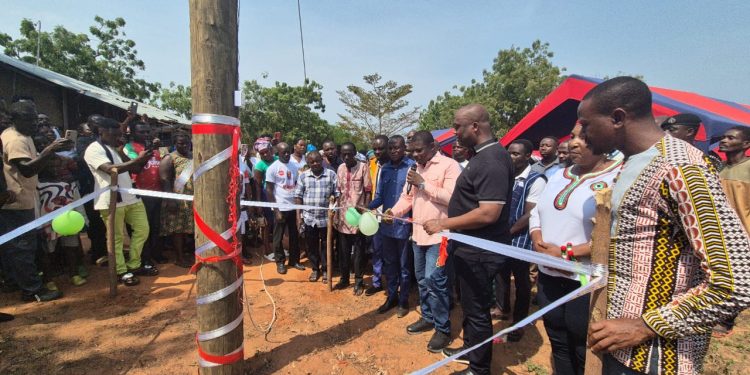
Mr Mensah was speaking at the commissioning of two rural electrification projects at Awurahae and Sapor in the Asuogyaman Constituency of the Eastern Region. The two communities, though located just a few kilometres from the Akosombo Hydropower Dam, had lived without electricity for decades.
Project details and cost
Awurahae, a fishing and aquaculture community with an estimated population of between 200 and 300, was connected to the national grid through a 2.4-kilometre network extension from Kudi Junction. The project, which commenced in 2024 and was completed in 2025, faced challenges due to difficult terrain and landscape conditions.
According to Mr Mensah, the scope of works included the installation of a 100 kVA distribution transformer, a medium-voltage network using 120 sqmm aluminium conductors, and a low-voltage network constructed with aerial bundled cables (ABC).
He disclosed that the total cost of the project was GH¢3.05 million, reflecting the distance, terrain and quality standards required to ensure a reliable electricity supply.
The Deputy Minister also commended the Member of Parliament for Asuogyaman and Deputy Minister for Finance, Thomas Ampem Nyarko, for what he described as his key role in championing the project.
‘Biggest Christmas gift’
Commissioning the projects on Christmas Day, December 25, 2025, Mr Ampem Nyarko described the electrification as the “biggest Christmas gift” to residents of the two communities, many of whom had lived their entire lives without access to electricity.
“The best Christmas present that President Mahama is giving you today is connecting you to the national grid. This electricity will significantly improve your living conditions,” he said.
He explained that the project was self-funded, with support from the Volta River Authority (VRA), the Ministry of Energy and Green Transition, and voluntary labour from members of the beneficiary communities.
The MP recalled that he had pledged ahead of the 2024 general elections to connect the communities to the national grid if given the mandate, a promise he said had now been fulfilled within a year of his third term in Parliament.
Roads, market and economic prospects
Beyond the electrification projects, Mr Ampem Nyarko assured residents that work was progressing steadily on the Akosombo–Kudi–Kofe–Gyekiti road, which forms part of government’s “Big Push” infrastructure agenda.
He said the contractor would remain on site until the final bitumen asphalt overlay is completed to make the road fully motorable.
The MP also announced plans to construct a 24-hour market in Awurahae to boost local economic activity, particularly in the fishing sector.
“With electricity and improved roads, the next step is to establish a functional market. Fisherfolk can preserve their catch, attract buyers from other areas and avoid distress sales due to spoilage,” he noted.
Teachers’ accommodation in Sapor
In Sapor, residents raised concerns about persistent teacher attrition, largely attributed to the lack of electricity and basic social amenities. Teachers posted to the community often leave within months, leading to combined classes and disruptions to teaching and learning.
Mr Ampem Nyarko said the extension of electricity, coupled with plans to construct a six-unit teachers’ accommodation facility, would help address the challenge.
“This community has suffered high teacher attrition, mainly due to the absence of electricity,” he said.
“We have secured a contract for the construction of six-unit teachers’ bungalows, and we expect the project to be completed in 2026.”
Community reactions
Residents of Awurahae and Sapor expressed excitement and relief following the commissioning of the projects.
A community leader at Awurahae, Daniel Bisi, said the electrification would have an immediate impact on livelihoods, particularly fishing and farming activities.
The Assembly Member for the Adjinadornir–Sapor Electoral Area, Noah Tetteh, also said access to electricity would improve education outcomes by encouraging teachers to stay and enabling students to study at night.
Amid drumming, dancing and jubilation, chiefs and residents of both communities expressed gratitude to the government, the Ministry of Energy and Green Transition, the Volta River Authority and the Asuogyaman MP for extending electricity to communities that had waited for decades to be connected to the national grid.